
What Are the Machining Difficulties of Multi-Cavity Molds for Plastic PET Buckets?
What Are the Machining Difficulties of Multi-Cavity Molds for Plastic PET Buckets?
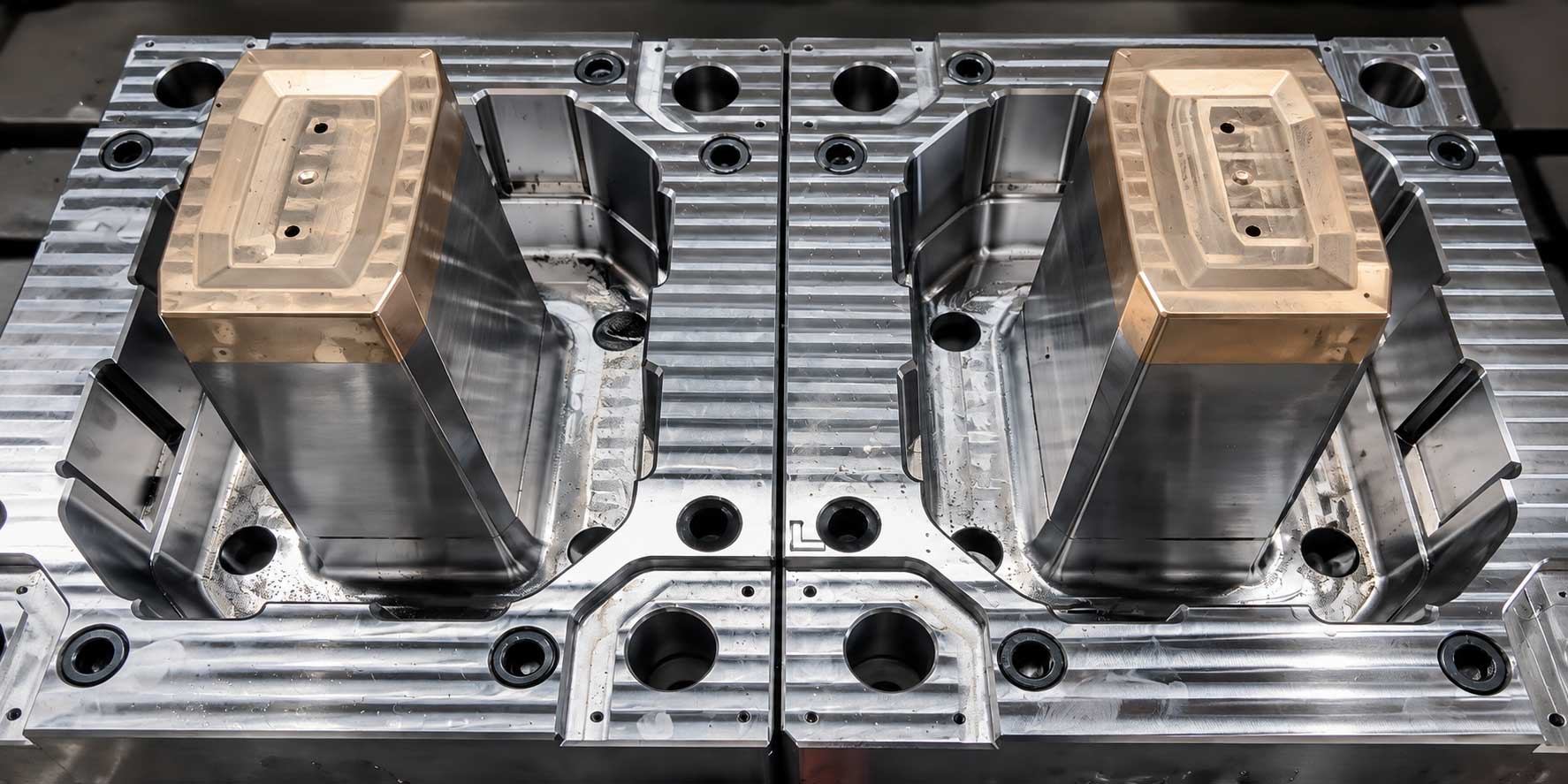
Multi-cavity molds for PET buckets (or large preforms) are among the more difficult categories in mold machining. Unlike ordinary PP or PE buckets, PET material is extremely temperature-sensitive, has a narrow melt temperature window, and exhibits complex crystallization behavior during cooling. Combined with the stringent requirements of multi-cavity molds for inter-cavity consistency, the machining difficulties are concentrated in several interrelated dimensions.
Difficulty One: Pressure Balance and Temperature Uniformity of the Hot Runner System
Multi-cavity PET molds almost always require a hot runner system. The more cavities there are, the longer the branch runners and the thicker the manifold plate, and the more complex the hot runner plate structure becomes. The core difficulty lies in: how to keep the pressure and temperature of the melt consistent when it reaches each cavity.
The melt flowability of PET is extremely sensitive to temperature. If the temperature difference on the hot runner plate exceeds ±1°C, the filling speed of different cavities will differ, ultimately causing inconsistency in preform weight. For large multi-cavity molds (such as 72-cavity, 96-cavity, or even 128-cavity), the number of temperature control points on the hot runner plate may reach over a hundred, each requiring independent control with temperature deviation controlled within ±0.5°C. Research indicates that the low-pressure filling balance of multi-cavity molds is inherently much more difficult than that of single-cavity molds, because the hot runner system relies on the balance of resistance pressure and requires back pressure to control the filling process.
Solution: Adopt a valve gate design, where each cavity has an independent heating zone and an independent thermocouple for temperature measurement, allowing individual adjustment of the feed temperature for each cavity. At the same time, optimize the temperature field distribution of the hot runner plate through CAE mold flow analysis, reasonably arrange the positions of temperature control points, and develop an automatic mold temperature control system. For large group-cavity molds, standardization and serialization of hot runner components can also reduce the difficulty of debugging and maintenance.
Difficulty Two: Cooling Uniformity and Structural Strength of the Cavity
The injection rate of PET injection molding can reach as high as 200 mm/s, and the injection pressure can reach 1200 bar. Under such high pressure, the cavity interior withstands severe pressure impact, while the exterior simultaneously carries low-temperature cooling water at around 8°C. The cavity must endure high-low temperature thermal expansion and contraction cycles within each molding cycle of about 10 seconds. If the cavity structure design is unreasonable, it may burst due to fatigue in less than a year.
At the same time, multi-cavity molds require all cavities to have the same cooling rate. If a cavity's cooling channel is too close to or too far from the cavity surface, that cavity's cooling speed will differ, and the preform's shrinkage rate and dimensional precision will deviate.
Solution: Adopt a stepped spiral water channel structure on the exterior of the cavity, rather than the traditional straight ring groove design. This structure disperses the weakest stress points of the cavity across the entire circumferential surface, rather than concentrating them in one axial direction, greatly improving the cavity's compressive strength during injection. At the same time, each cavity is equipped with independent distributed cooling pipes to precisely balance mold temperature and reduce internal stress and uneven shrinkage. For high-cavity-count molds, the water channel design needs to ensure that all cavities achieve balance for more efficient cooling.
Difficulty Three: Inter-Cavity Consistency Control in Cavity Machining
Each cavity of a multi-cavity PET mold needs to be machined to almost exactly the same dimensions. Taking preform mold industry practice as an example, the internal dimensional precision requirement for a single-cavity mold is within 0.01 mm, and the preform weight tolerance for each cavity needs to be controlled within ±0.3 g, with wall thickness variation not exceeding 0.10 mm. The more cavities there are, the harder it is to guarantee this "consistency" requirement.
The difficulty lies in: during machining, tools wear, the machine tool undergoes thermal deformation, and every re-clamping introduces new positioning errors. If the machining strategy is "one cavity at a time," errors will accumulate cavity by cavity.
Solution: Adopt five-axis simultaneous high-speed milling to complete rough and semi-finish machining of multiple cavities in a single clamping, greatly reducing positioning errors. Control the spindle speed at 12000-18000 r/min, adopt a strategy of small depth of cut and fast feed, reduce the impact of cutting force on cavity deformation, and ensure the profile tolerance error of the cavity surface ≤0.003 mm. After finishing every 1-2 cavities, pause machining to inspect the machine's positioning accuracy, avoiding error accumulation caused by tool wear or machine vibration. Positioning holes and guide pin hole systems are machined with CNC coordinate boring machines, with hole position tolerance controlled within 0.002 mm, ensuring coaxiality and repeat positioning accuracy during mold closing.
Difficulty Four: Reliability of the Demolding and Ejection System
Demolding PET preforms or buckets is a delicate operation. PET remains soft and elastic at higher temperatures. If the ejection timing or method is wrong, the product may be deformed during ejection, or in multi-cavity molds, products from different cavities may collide with each other during ejection, causing welding or damage. For large PET buckets, the force distribution during ejection is even more critical, and excessive local force can cause the bucket wall to whiten or deform.
Solution: Adopt new preform stripping technology to achieve more stable and convenient demolding. For multi-cavity molds, the ejection system must ensure that products from all cavities are pushed out synchronously and uniformly. The arrangement of ejector pins needs to cover the key support points of the product. For bucket-type products, special attention must be paid to the uniformity of ejection support at the corners and the middle of the long sides of the frame. At the same time, the design of the stripper ring or demolding mechanism needs to match the fit precision of the core to avoid scratching the product during demolding.
Difficulty Five: Sealing Performance of the Parting Surface and Insert Fits
When PET melt fills at high pressure and high speed, its "penetrating power" against the parting surface and insert fit clearances is extremely strong. If the fit precision of the parting surface is insufficient, or if the fit clearance between inserts and the mold core is too large, the melt will penetrate into the clearance and form flash. For multi-cavity molds, the parting surface of every cavity needs to achieve the same sealing standard.
Solution: Control the flatness error of the parting surface within 0.001 mm, and the fit clearance of guide pins and guide bushings within 0.002 mm. For insert fits, adopt stricter fit tolerance technology to improve the matching precision between individual mold cavities from 0.02 mm to within 0.01 mm. The material selection for the mold core and inserts needs to consider wear resistance and dimensional stability, such as S136 pre-hardened mold steel. After machining, stress relief annealing is performed to eliminate residual stress and avoid deformation in subsequent processes.
Difficulty Six: Matching of Mold Materials and Heat Treatment
PET processing temperatures are high (melt temperature around 280°C), and PET material itself has a certain wearing and chemical effect on the mold. Under repeated high-low temperature cycles and high-pressure impact, the materials of the cavity and core of a multi-cavity mold must simultaneously possess sufficient hardness, toughness, and corrosion resistance.
Solution: Use high-quality mold steel such as Swedish S136 for the cavity and core, with hardness controlled at HRC48-52. Perform stress relief annealing after rough machining, and low-temperature aging treatment after semi-finish machining to further release internal stress before proceeding to finish machining. For cavities that work under high temperature and high pressure for long periods, special attention must also be paid to the sealing design of the stepped spiral water channels to avoid cooling water leakage under high pressure.
Summary
The machining difficulties of multi-cavity molds for plastic PET buckets ultimately come down to a problem of systematic precision control. Temperature uniformity of the hot runner, cooling consistency of the cavity, dimensional consistency of the cavities, reliability of demolding, sealing performance of the parting surface, and durability of the material—if any one of these links deviates, it will manifest in the final product as weight differences, uneven wall thickness, dimensional out-of-tolerance, or flash.
Solving these difficulties does not rely on the ultimate precision of any single operation, but on full-process control from hot runner design, cooling structure, machining strategy, error compensation, to final inspection verification. Incorporate every step into a closed loop that can be inspected and compensated, and the inter-cavity consistency of multi-cavity PET molds can be guaranteed.
