


Rattan-Weave Design Multi-Size Household Pedal Trash Can Mold — Product Introduction (Motek Daily Necessities Mold Series)
Rattan-Weave Design Multi-Size Household Pedal Trash Can Mold — Product Introduction (Motek Daily Necessities Mold Series)
Product Positioning
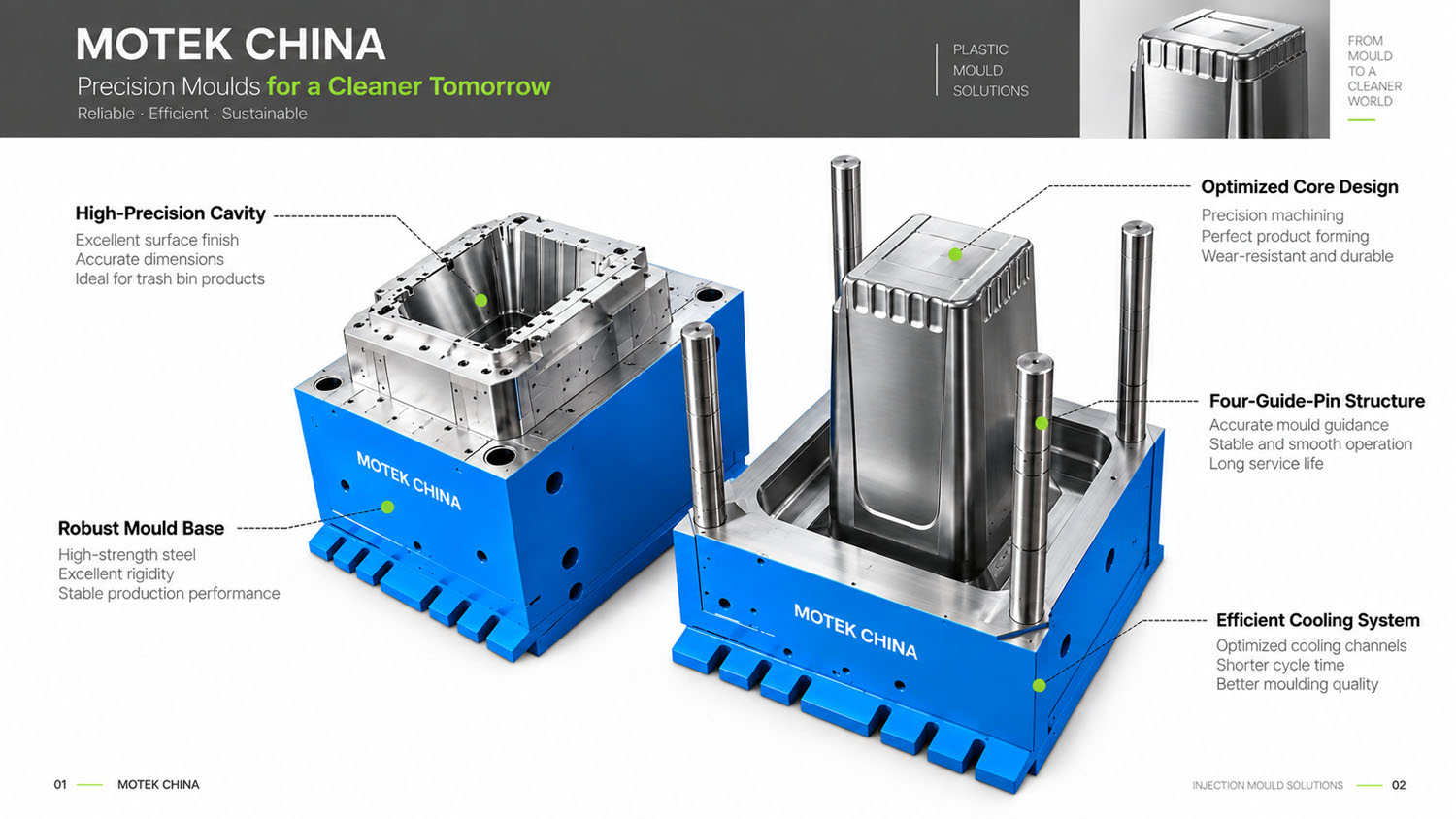
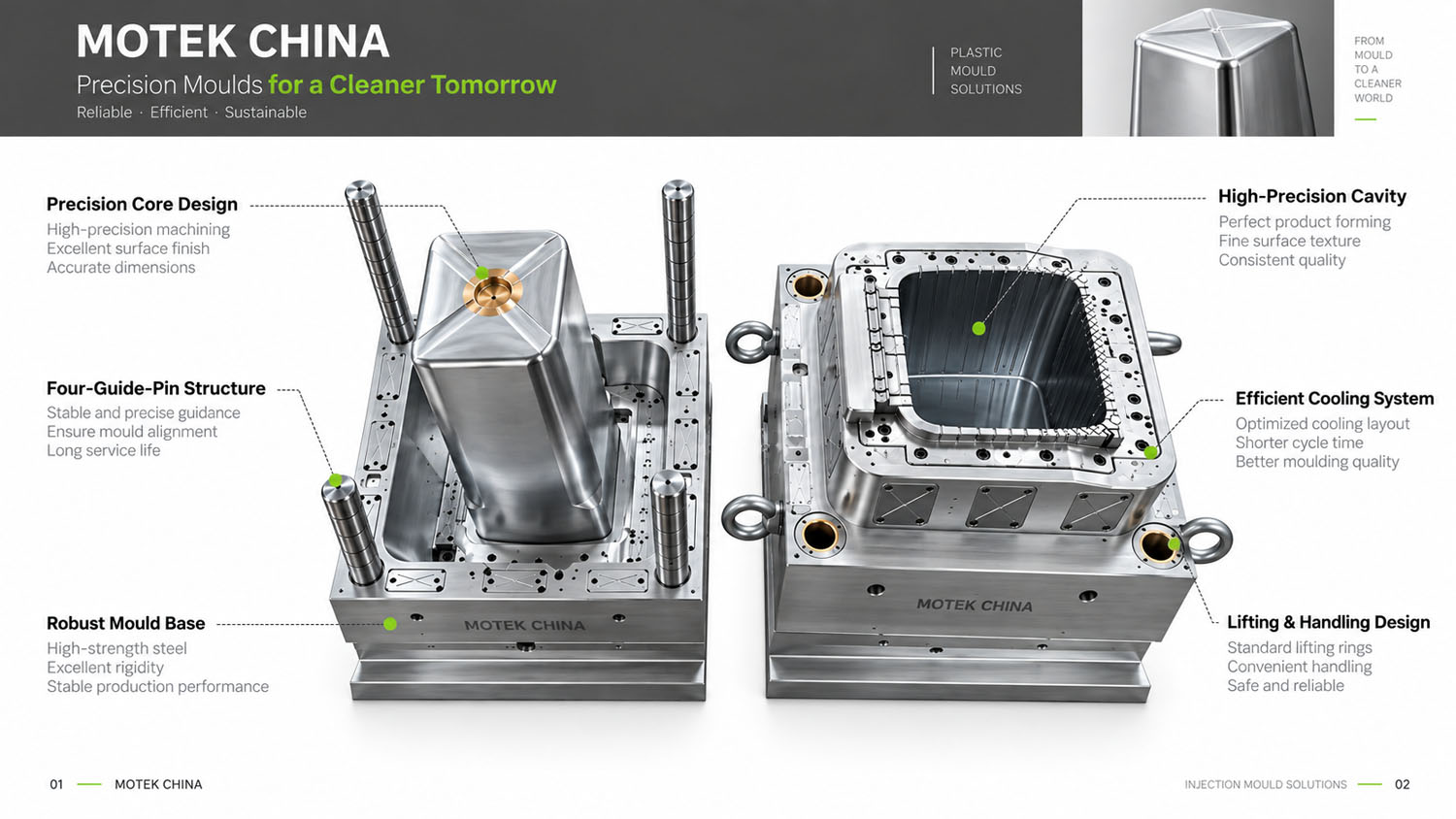
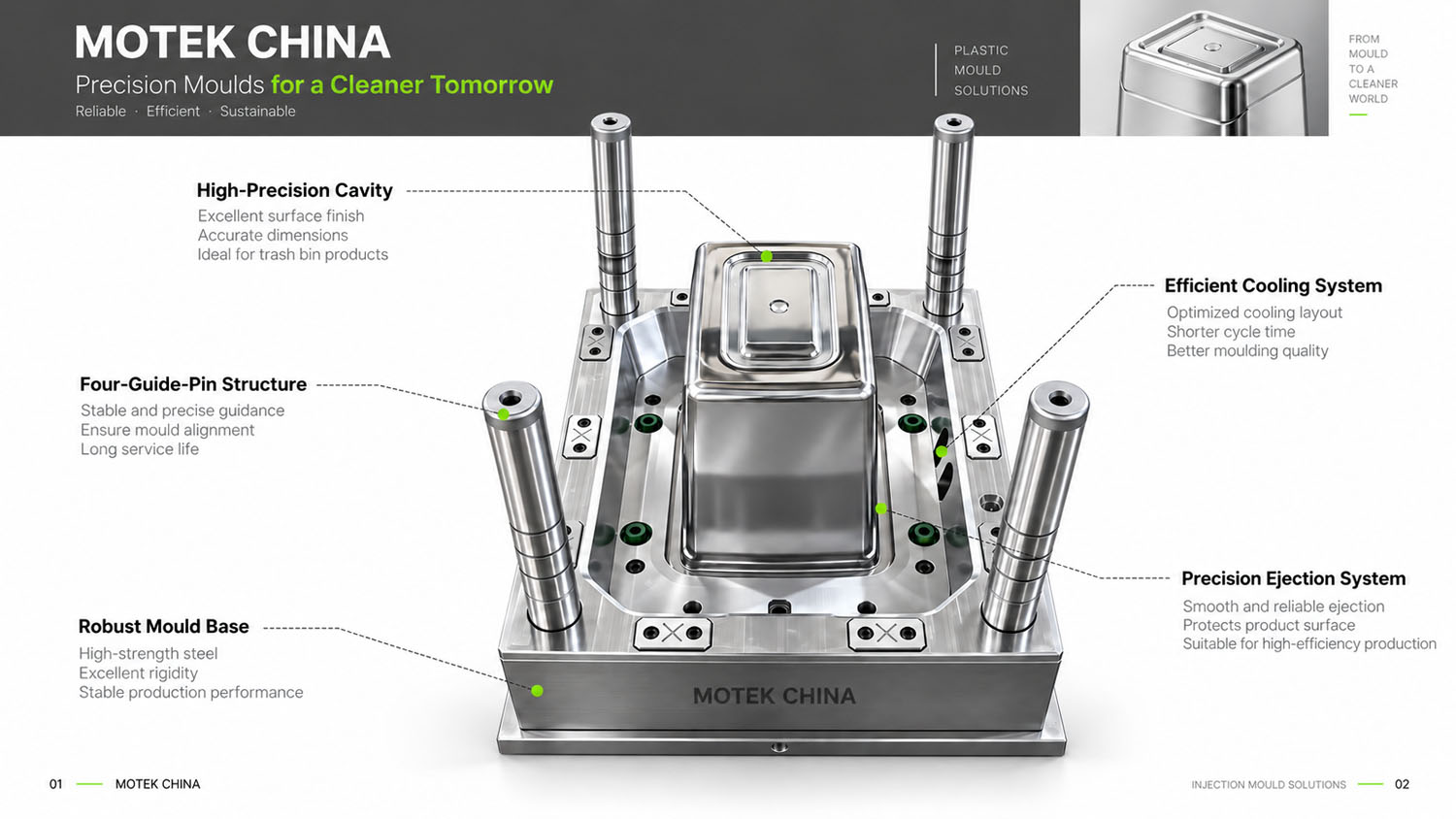
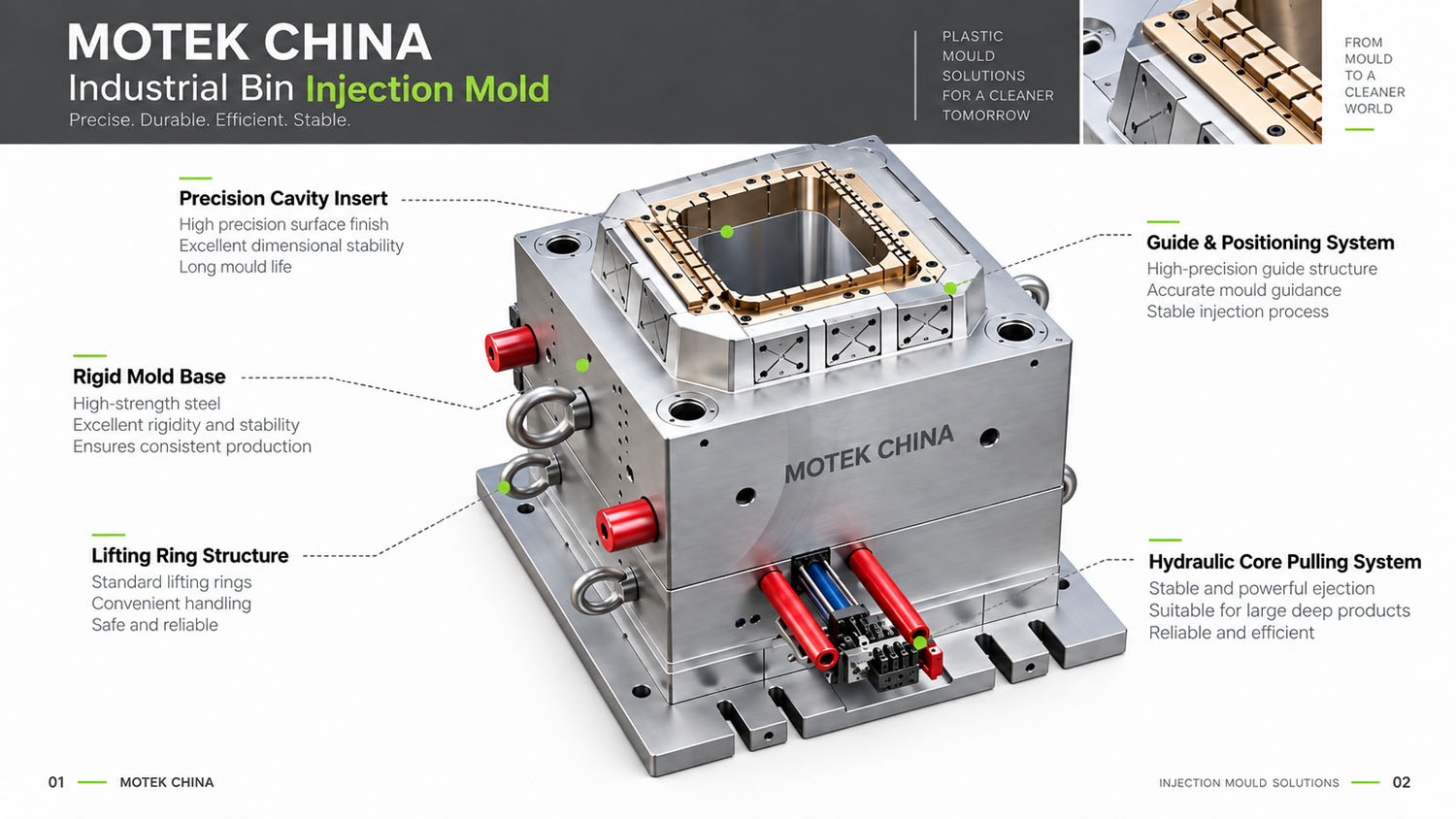
Motek introduces dedicated injection molds for rattan-weave design household pedal trash cans available in multiple sizes. This product family combines the natural warmth of rattan-weave aesthetics with the hygiene of hands-free pedal operation, offered in a range of capacities (typically 5L to 20L) to suit different rooms—bathrooms, bedrooms, living rooms, and kitchens. The multi-size product line requires a mold strategy balancing texture consistency across sizes, modular tooling for cost efficiency, and pedal mechanism scalability. The core challenges in mold development lie in rattan-weave texture replication on curved surfaces of varying diameters, precision forming of pedal linkage and lid hinge across sizes, and round-body warpage control for consistent lid fit. Motek addresses these through texture etching, cavity layout, and cooling design, helping customers achieve stable mass production of multi-size rattan-weave pedal bins.
Core Specifications
| Item | Specification |
|---|---|
| Applicable Plastics | PP / HDPE (food-contact grade optional; PP commonly used for household applications) |
| Mold Material | S136 / 1.2316 corrosion-resistant steel for textured areas; P20/718H/NAK80 for cavity and core |
| Number of Cavities | 1×1 per size primarily; 1×2 evaluable for compact sizes |
| Mold Life | 300,000–800,000 shots |
| Cycle Time | 25–45 seconds (depending on body size and cooling design) |
| Mold Base Standard | LKM / HASCO / DME or customer-specified |
| Runner System | Hot runner recommended (reduces cold slugs and stress) / Cold runner optional |
| Texture Treatment | Imitation rattan weave texture etching (consistent pattern across all sizes) |
| Pedal Mechanism | Pedal pivot, linkage mounting, and lid hinge features integrally formed per size |
Product Features
Consistent Rattan-Weave Texture Across Multiple Sizes.
A multi-size product family must present a unified visual identity. Motek performs etching on cavity surfaces based on customer-provided rattan samples, with texture depth, pattern scale, and weave alignment calibrated across different body diameters. Smaller bins use proportionally scaled patterns to maintain visual coherence when displayed together. S136 or 1.2316 corrosion-resistant steels are selected for textured areas to ensure clear details and long-term rust-free service.
Demolding Protection for Textured Curved Surfaces.
Rattan-weave textures on curved cylindrical surfaces are susceptible to scraping during demolding, particularly where draft angles vary with diameter. Motek provides ample draft angles in textured areas and applies anti-scratch treatment to moving components such as sliders and inserts. Smaller-diameter bodies may require split cavity or slider-assisted demolding to prevent texture damage.
Precision Forming of Pedal Linkage and Lid Hinge Across Sizes.
The pedal mechanism must scale appropriately with body size—compact bins require proportionally smaller pivot and linkage dimensions while maintaining reliable actuation. Motek forms pedal pivot points, linkage mounting features, and lid hinge positions with tight dimensional tolerance for each size, ensuring smooth pedal actuation and reliable lid opening/closing. For metal-reinforced pedal mechanisms, insert seating features are designed with proper clearances.
Round-Body Warpage Control for Consistent Lid Fit.
Each size in the product family requires reliable lid fit. Motek evaluates shrinkage distribution for each diameter through mold flow analysis, applies pre-deformation compensation to the cavity, and adopts annular balanced cooling channels to equalize cooling rates around the circumference, ensuring the body mouth remains circular for consistent lid contact.
Modular Tooling Strategy for Cost Efficiency.
For a multi-size product line, Motek can design molds with interchangeable inserts—sharing a common mold base while swapping cavity/core inserts for different sizes. This approach reduces tooling investment across the size range while maintaining dimensional accuracy. Insert positioning and locking structures are precision-controlled to ensure accurate cavity alignment after insert changes.
Household Durability and Cleanability.
Household environments involve occasional moisture and frequent cleaning. Motek ensures cavity surfaces are smooth and non-porous for easy wiping, with all corners and rib roots rounded to eliminate crevices. The textured exterior is designed to resist staining while maintaining the rattan aesthetic.
Stability Across Sizes.
Smaller bins are lightweight and may shift during pedal operation. Motek forms anti-slip foot pad mounting positions or integrally formed anti-slip structures on the bin bottom for each size, ensuring stable placement and preventing sliding during pedal actuation.
Applications
Motek rattan-weave design multi-size household pedal trash can molds are suitable for:
- Living room decorative pedal rattan-weave bins (5–20L)
- Bathroom pedal rattan-weave waste bins
- Bedroom pedal rattan-weave trash cans
- Kitchen pedal rattan-weave bins
- Multi-room coordinated rattan-weave pedal bin sets
Service Process
After the customer provides 3D product drawings for each size, rattan texture samples or reference images, and pedal mechanism plans, Motek completes texture etching plan confirmation (with cross-size pattern calibration), mold flow analysis (including textured area filling evaluation, round-body warpage compensation, and pedal mounting verification), and mold structure design; cavity steel is selected per texture requirements, with texture samples provided for customer confirmation before etching; progress and key milestones are regularly reported during processing. During trial molding, emphasis is placed on verifying texture consistency across sizes, pedal actuation smoothness, lid fit, and round-body dimensional accuracy, with samples provided for final sign-off. Before shipment, molds undergo anti-rust treatment and action testing, with water circuit diagrams, consumable parts lists, and texture maintenance notes provided. Technical support is available during the warranty period, with lifetime maintenance consultation.


Motek — From single-size to multi-size rattan-weave pedal bins, providing reliable mold solutions for coordinated household product lines.
