


240L–660L Industrial Trash Can Mold — Product Introduction (Motek Daily Necessities Mold Series)
240L–660L Industrial Trash Can Mold — Product Introduction (Motek Daily Necessities Mold Series)
Product Positioning
Motek introduces dedicated injection molds for 240L–660L industrial trash cans (wheelie bins). These large-capacity containers are designed for municipal sanitation, industrial facilities, commercial complexes, and large-scale waste collection—where mechanized handling, heavy loads, and outdoor durability are critical. Unlike household or small public bins, industrial wheelie bins must meet strict dimensional standards (such as EN840 for mobile waste containers), withstand mechanical lifting by garbage trucks, and resist UV exposure, impact, and chemical attack over years of service. The core challenges in mold development lie in deep-cavity cooling and demolding for very large bodies, structural reinforcement at wheel housings and lifting interfaces, and dimensional precision for automated handling compatibility. Motek addresses these through heavy-duty mold construction, optimized cooling systems, and robust ejection mechanisms, helping customers achieve stable mass production of industrial wheelie bins.
Core Specifications
| Item | Specification |
|---|---|
| Applicable Plastics | HDPE (UV-stabilized, impact-resistant, high-rigidity grades) |
| Mold Material | P20 / 718H / 2738 (cavity and core), H13 for wear areas; heavy-duty mold base |
| Number of Cavities | 1×1 (single cavity for large bodies) |
| Mold Life | 500,000–1,000,000 shots |
| Cycle Time | 60–240 seconds (depending on bin size; industry reference for 240L: ≤60s with optimized cooling) |
| Injection Machine | 1500T–2400T+ (depending on bin size; 660L requires ~1500T) |
| Runner System | Hot runner (multi-point, balanced filling) |
| Ejection Method | Ejector blocks + stripper plate + air-assist (for vacuum release) |
Product Features
Heavy-Duty Mold Construction for Large Deep-Cavity Bodies.
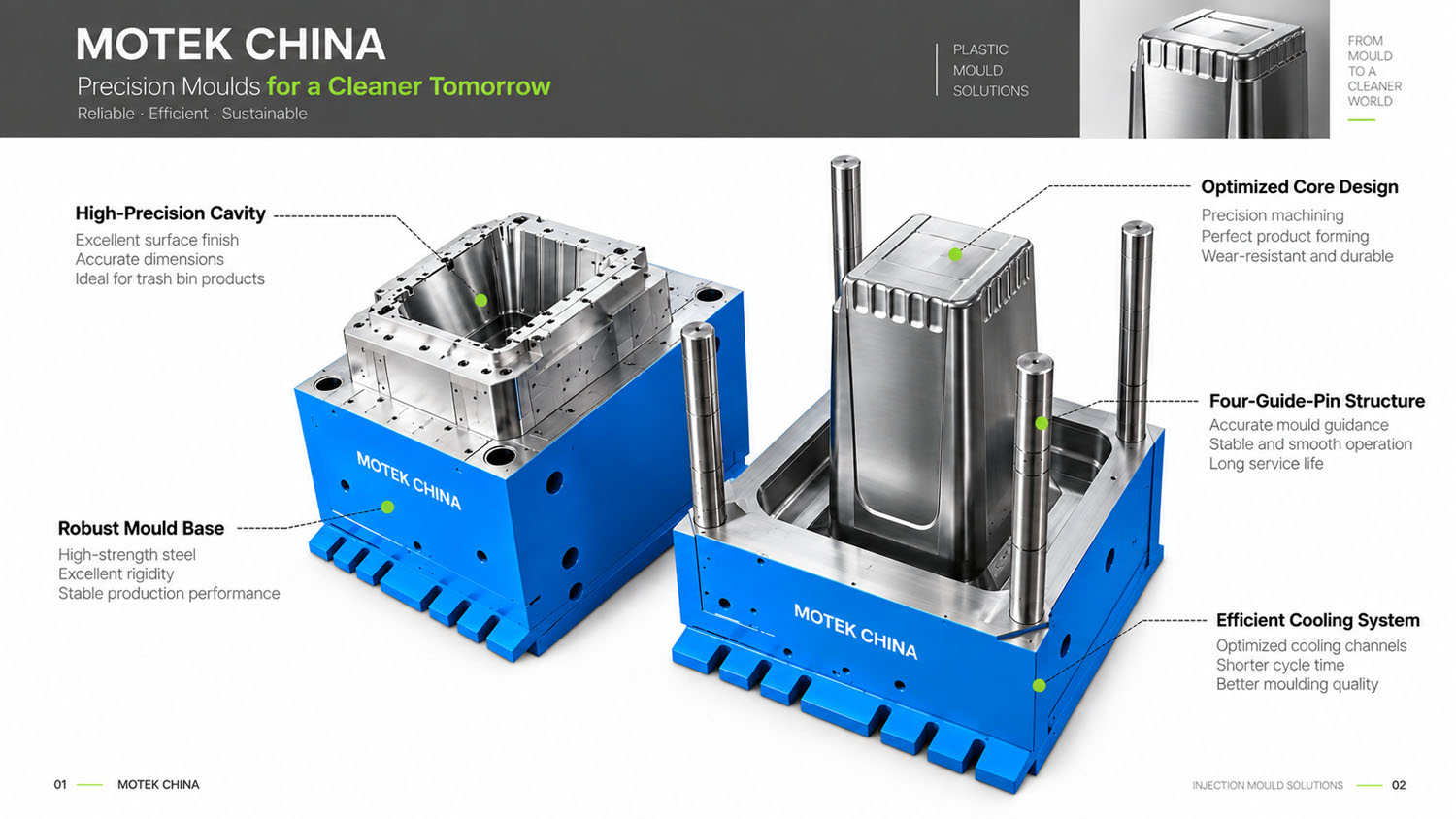
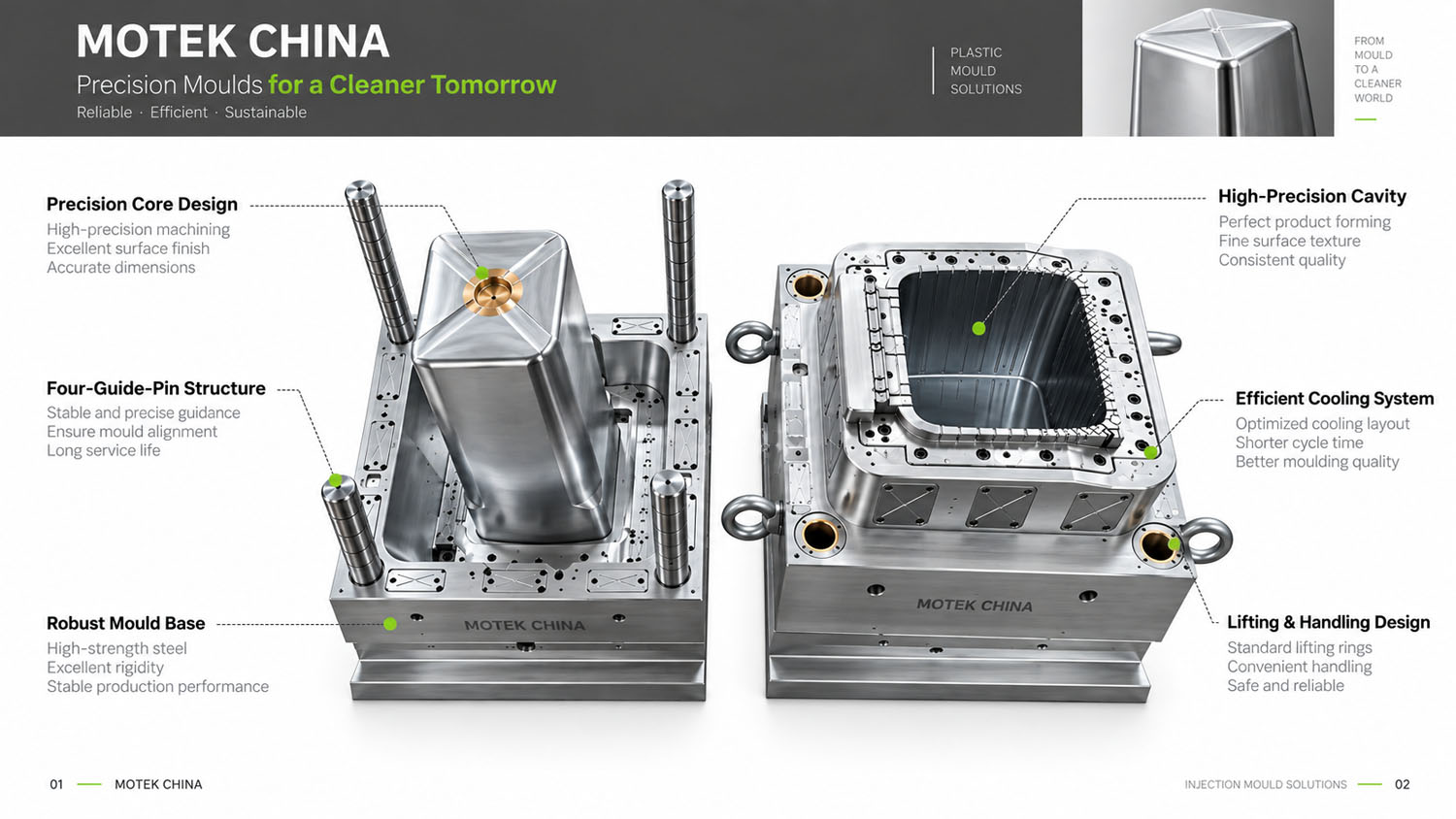
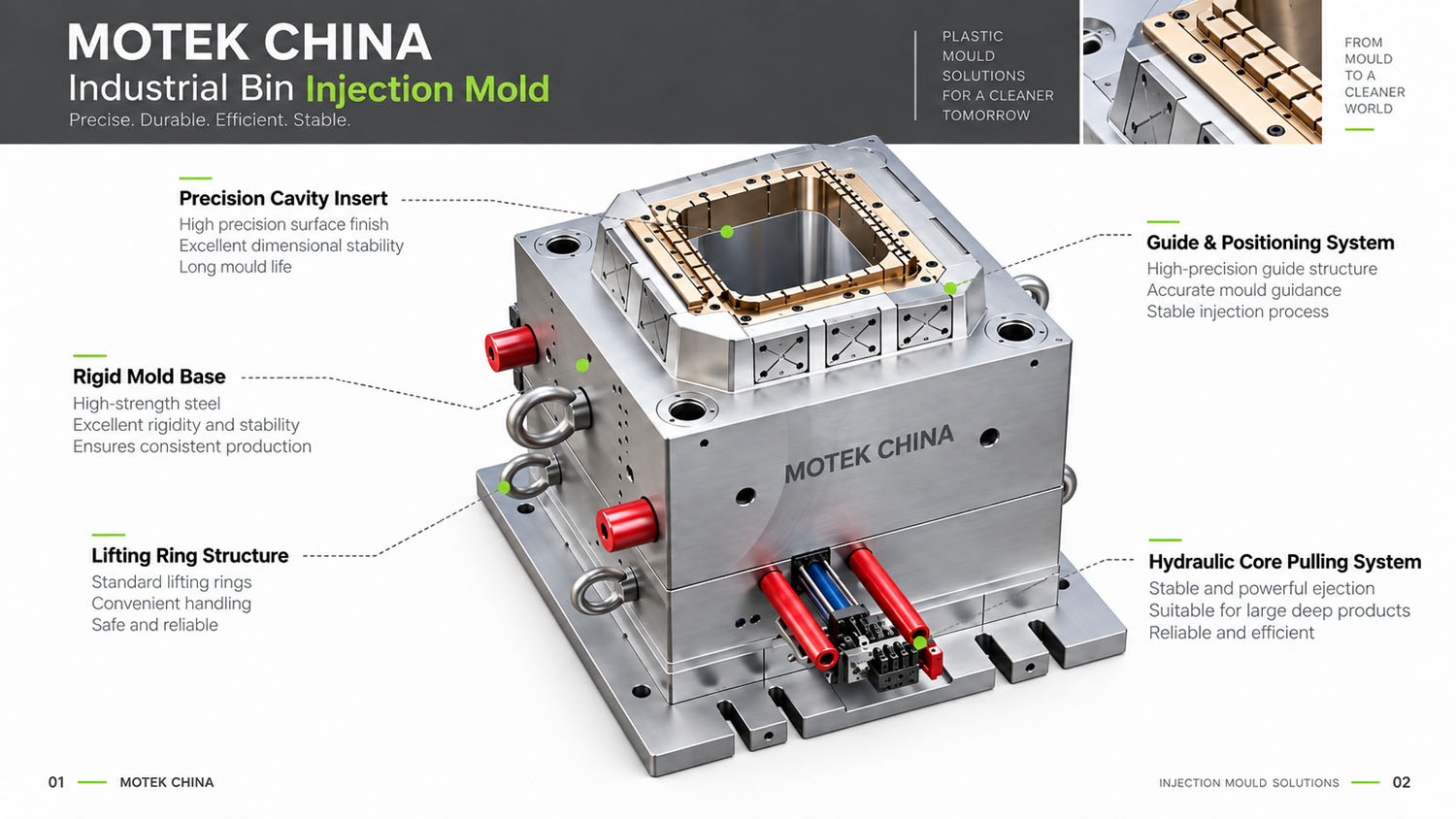
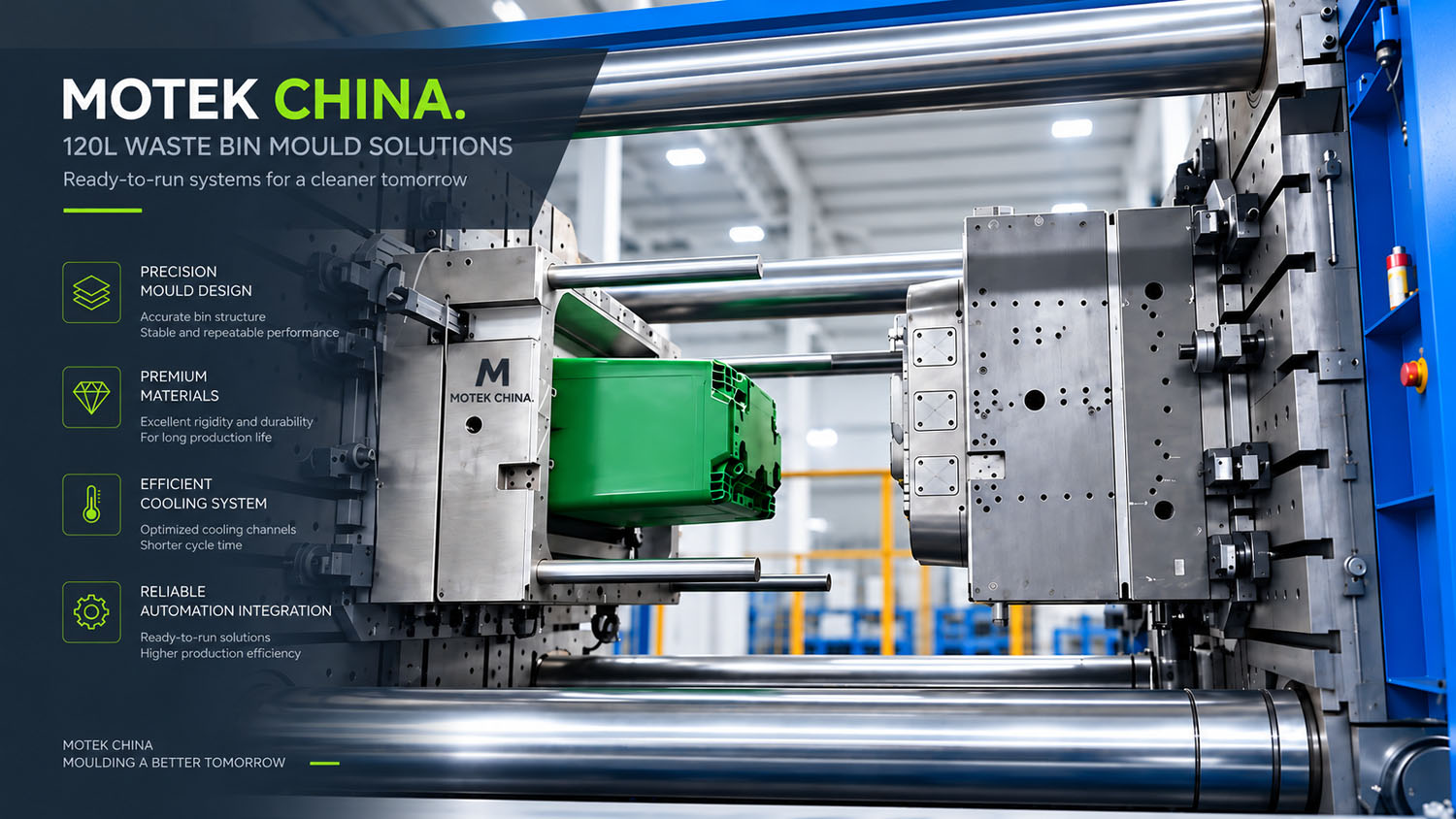
240L–660L bins are among the largest injection-molded daily products, requiring massive mold bases and robust support structures. Motek constructs molds with heavy-duty steel plates, adequate support pillars behind core inserts, and rigid clamping systems to resist deflection during high-pressure injection. The 660L bin mold typically requires a mold size around 2500×1800×1500mm and an injection machine of 1500T or above.
Optimized Cooling for Cycle Time Reduction.
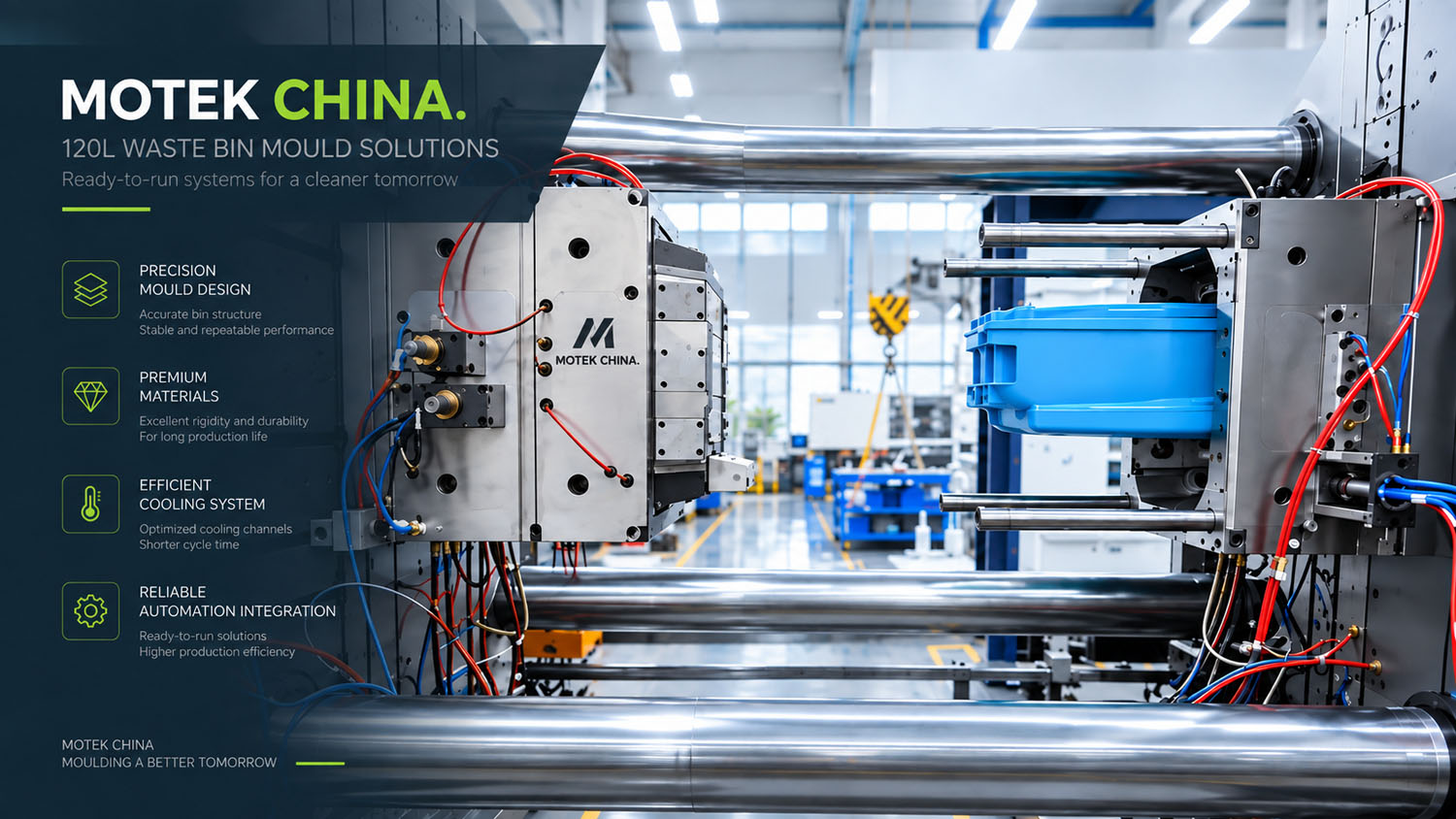
Cooling is the largest portion of the cycle for large bins. Motek adopts multi-zone independent cooling manifolds (typically 7 or more circuits) covering cavity and core sections separately, with large inlet/outlet connectors and valve-controlled water flow for precise temperature management. Conformal cooling channels follow part contours to minimize hot spots and warpage. For 240L bins, cycle times of ≤60 seconds (including robotic pickup) are achievable with optimized cooling.
Structural Reinforcement at Wheel Housings and Lifting Interfaces.
Industrial wheelie bins feature integrated wheel housings, lifting trunnions, and reinforced handles that must withstand mechanical handling. Motek forms these features with side-action sliders and optimized wall thickness, avoiding stress concentration that could cause cracking under load. Rib layout is carefully balanced—sufficient for strength without excessive material that would increase weight and cost.
Dimensional Precision for EN840 Compatibility.
Industrial wheelie bins must comply with EN840 standards for compatibility with garbage truck lifting mechanisms. Motek applies tight tolerance control to lifting interfaces, wheel positions, and overall dimensions, ensuring bins interface reliably with automated handling equipment. Mold flow analysis verifies dimensional stability across production batches.
Venting and Vacuum Release for Deep Cavities.
Large deep-cavity bins are prone to air traps at bottom corners and vacuum adhesion during demolding. Motek designs venting at critical locations (bottom corners, rib intersections) to prevent air traps, and incorporates air-assist ejection or large-area ejector systems to overcome vacuum release forces.
UV-Stabilized Material Coordination.
Industrial bins are exposed to sunlight for extended periods. Motek coordinates with customers on UV-stabilized HDPE grades and adjusts cavity dimensions to account for shrinkage characteristics of modified materials. Wall thickness at impact-prone areas (corners, base edges, wheel housings) is appropriately increased for durability.
Heavy-Duty Ejection System.
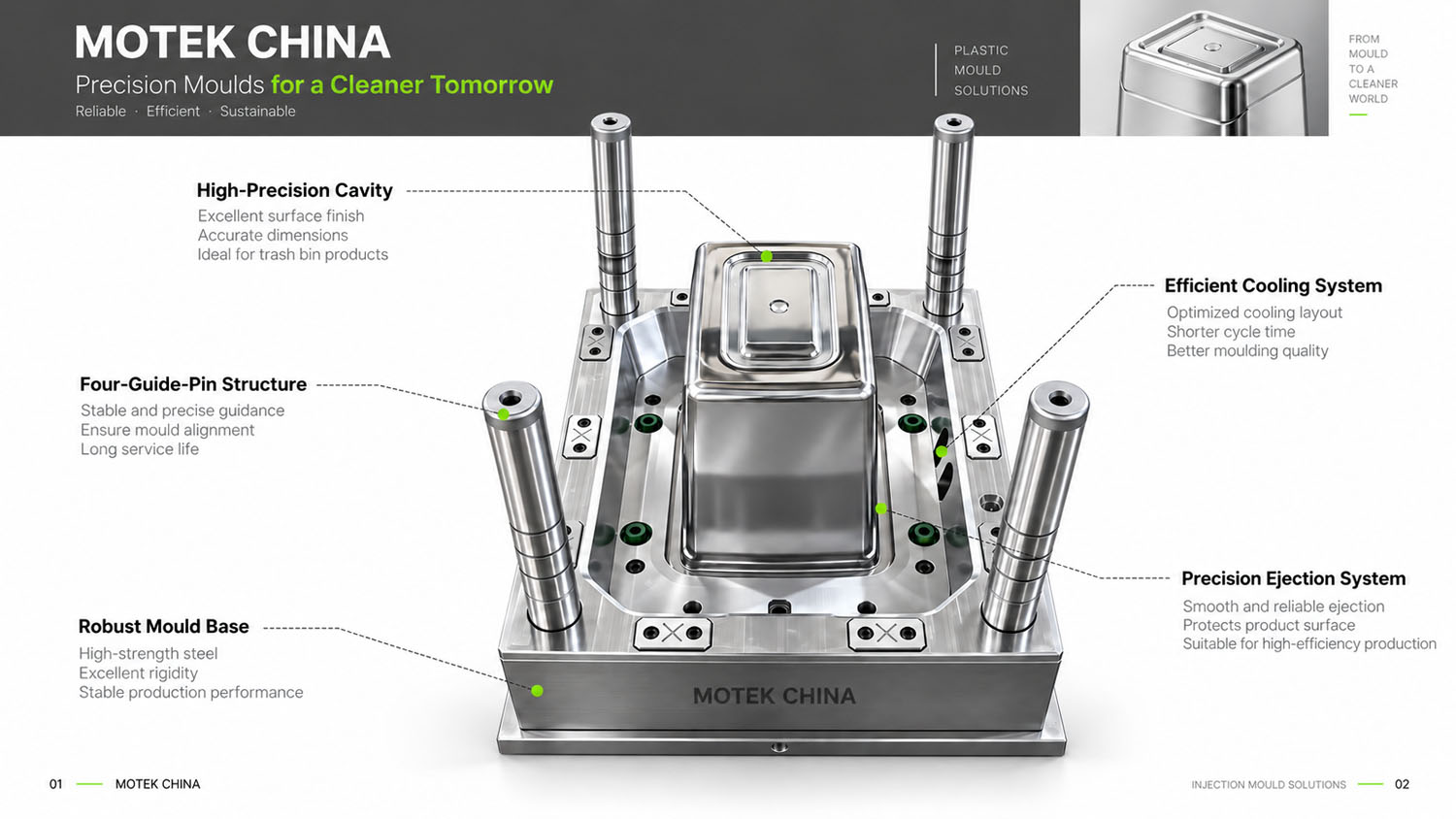
Ejection of large, deep parts requires substantial force. Motek designs ejection systems using ejector blocks, stripper plates, or air valves as appropriate for the bin geometry. Ejection mechanisms are designed for simplicity and easy maintenance, with accessible components for servicing.
Applications
Motek 240L–660L industrial trash can molds are suitable for:
- Municipal sanitation wheelie bins (240L, 360L, 660L)
- Industrial facility waste containers
- Commercial complex large-capacity bins
- Recycling collection wheelie bins
- Automated garbage truck compatible containers (EN840)
Service Process
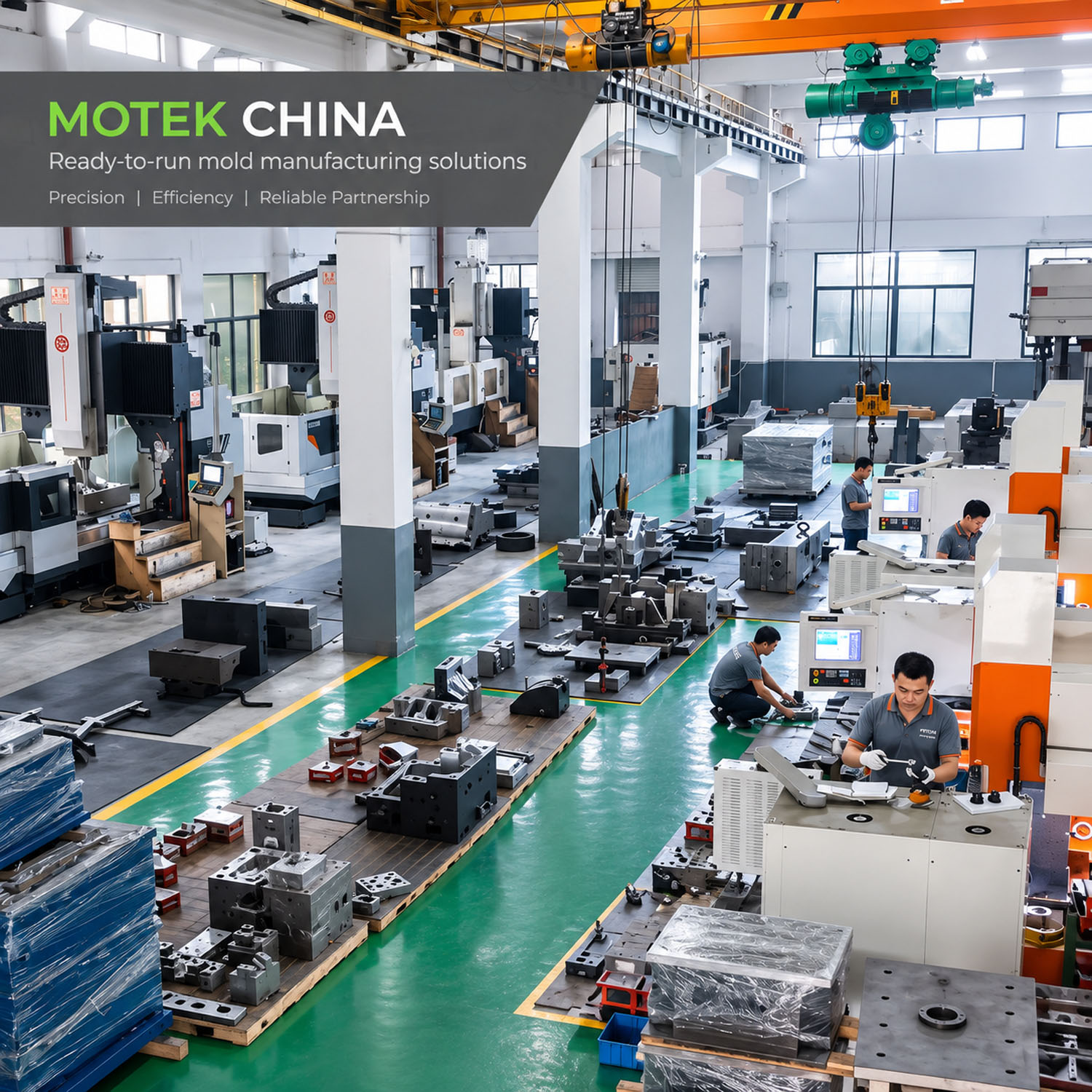
After the customer provides 3D product drawings, capacity specifications, EN840 compliance requirements, and target output, Motek completes mold flow analysis (including deep-cavity filling evaluation, cooling optimization, and warpage prediction) and mold structure confirmation; heavy-duty mold steel and hot runner systems are procured according to agreed specifications; progress and key milestones are regularly reported during processing. During trial molding, emphasis is placed on verifying dimensional accuracy, structural integrity at load-bearing areas, ejection smoothness, and cycle time performance, with samples and inspection reports provided. Before shipment, molds undergo anti-rust treatment and action testing, with water circuit diagrams, hot runner wiring diagrams, consumable parts lists, and maintenance instructions provided. Technical support is available during the warranty period, with lifetime maintenance consultation.
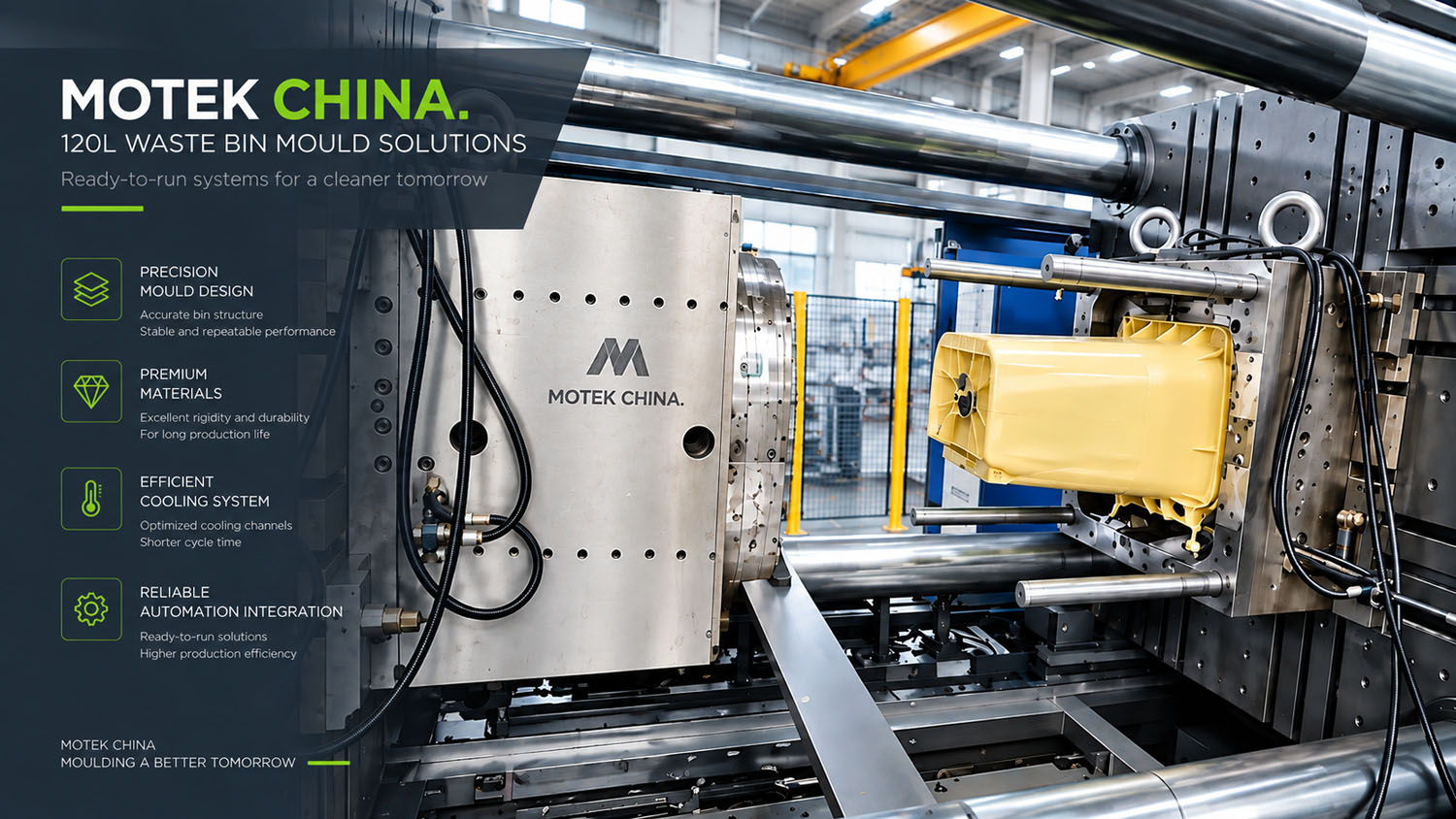
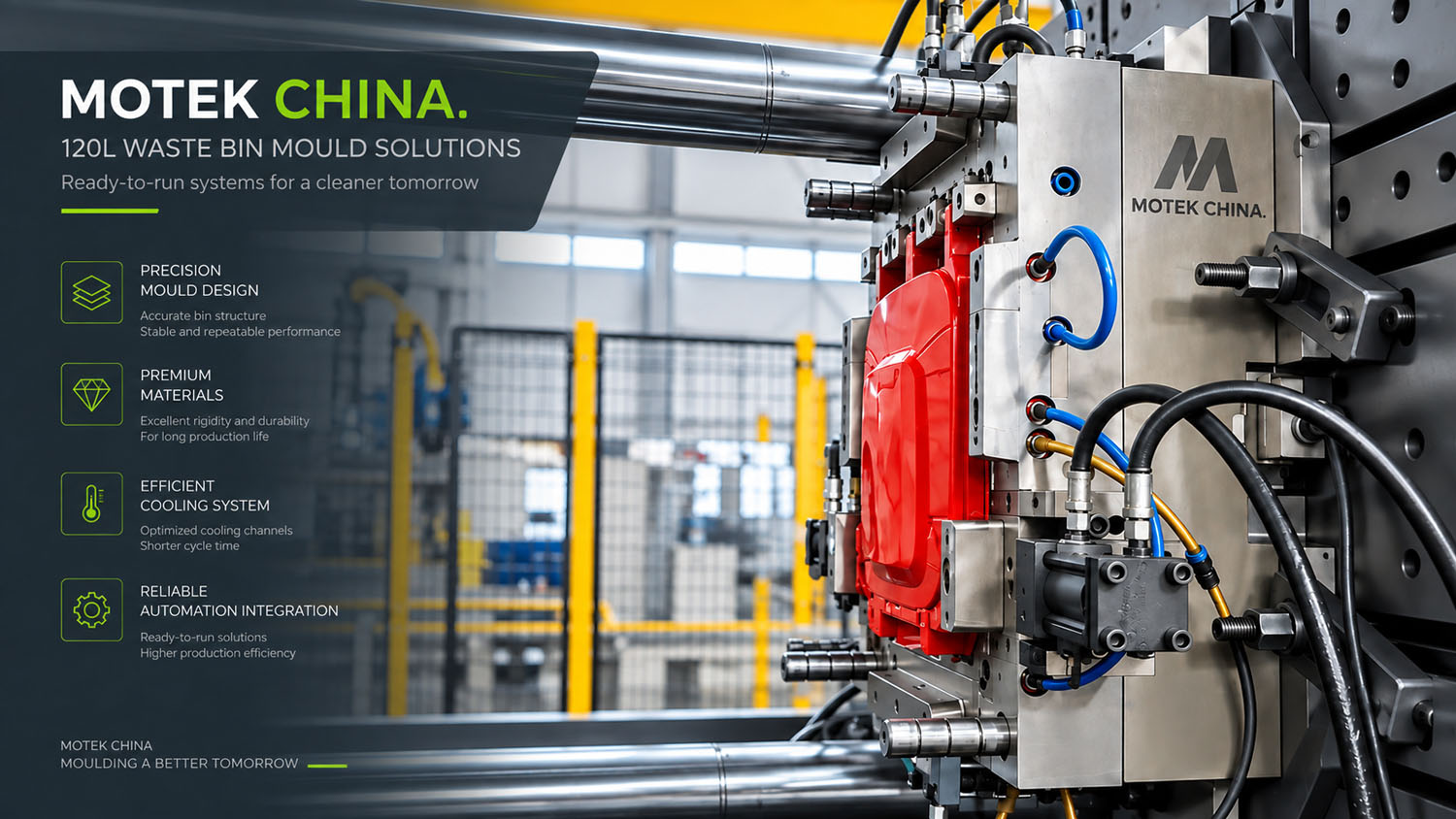
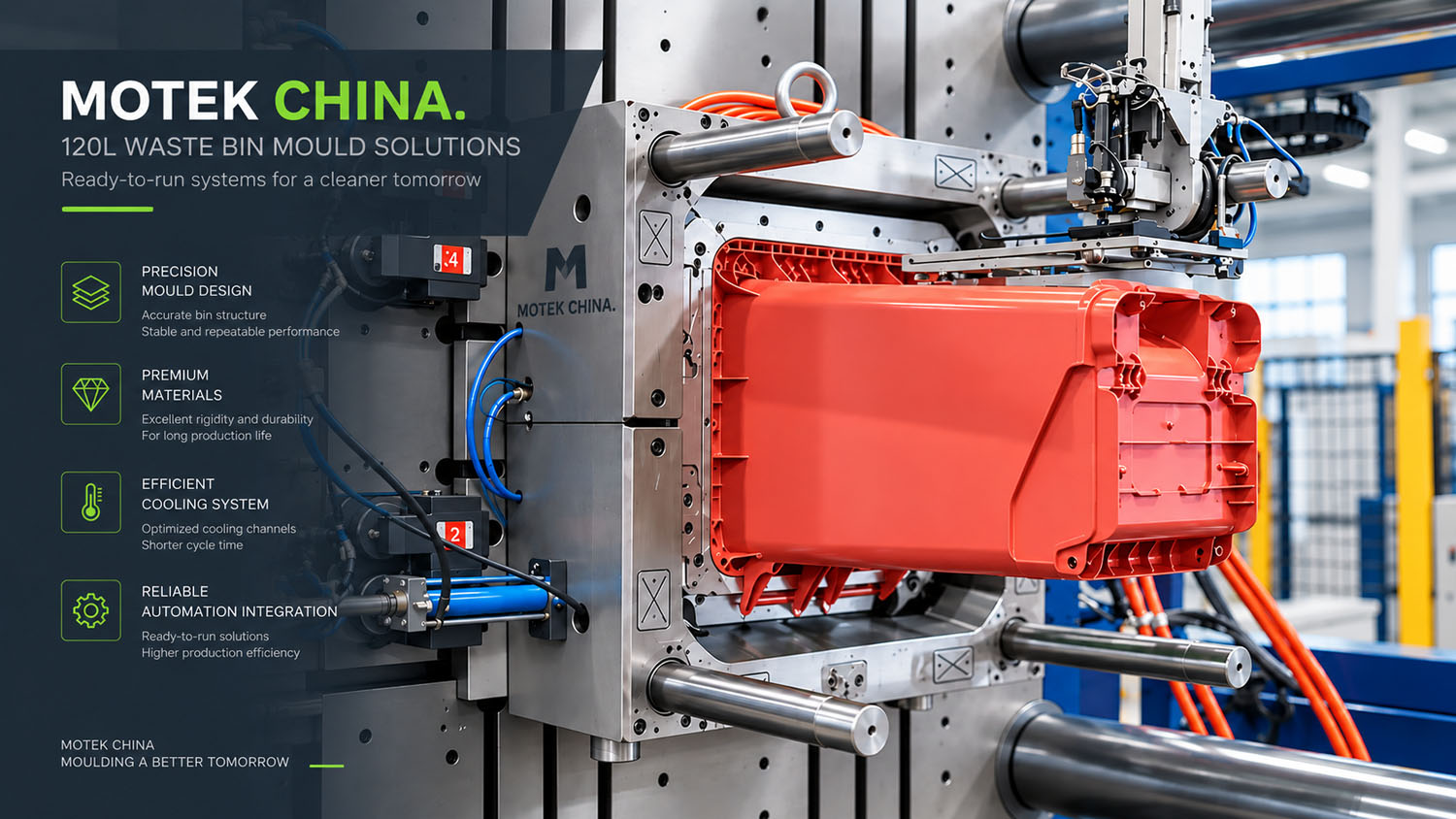
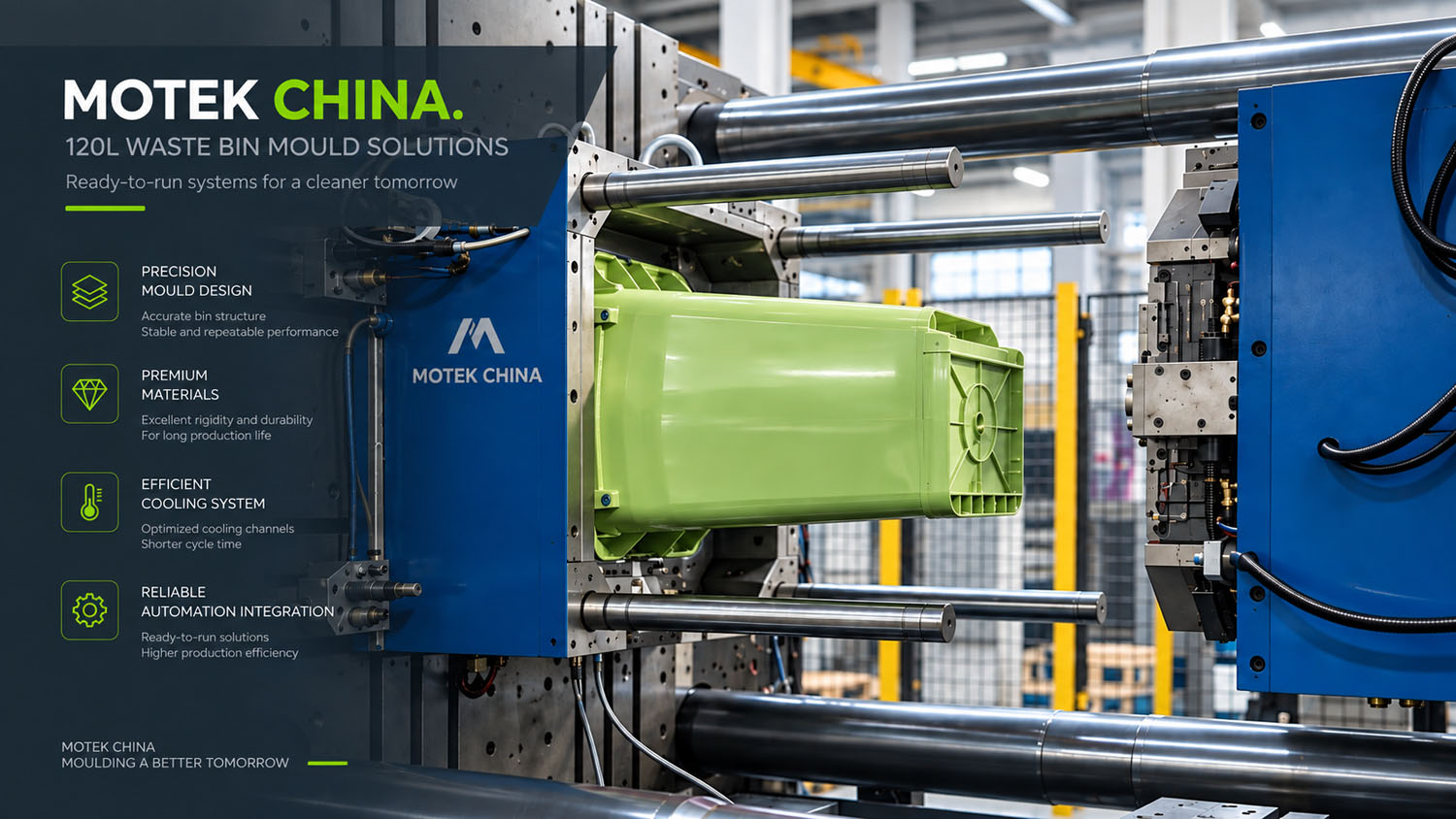
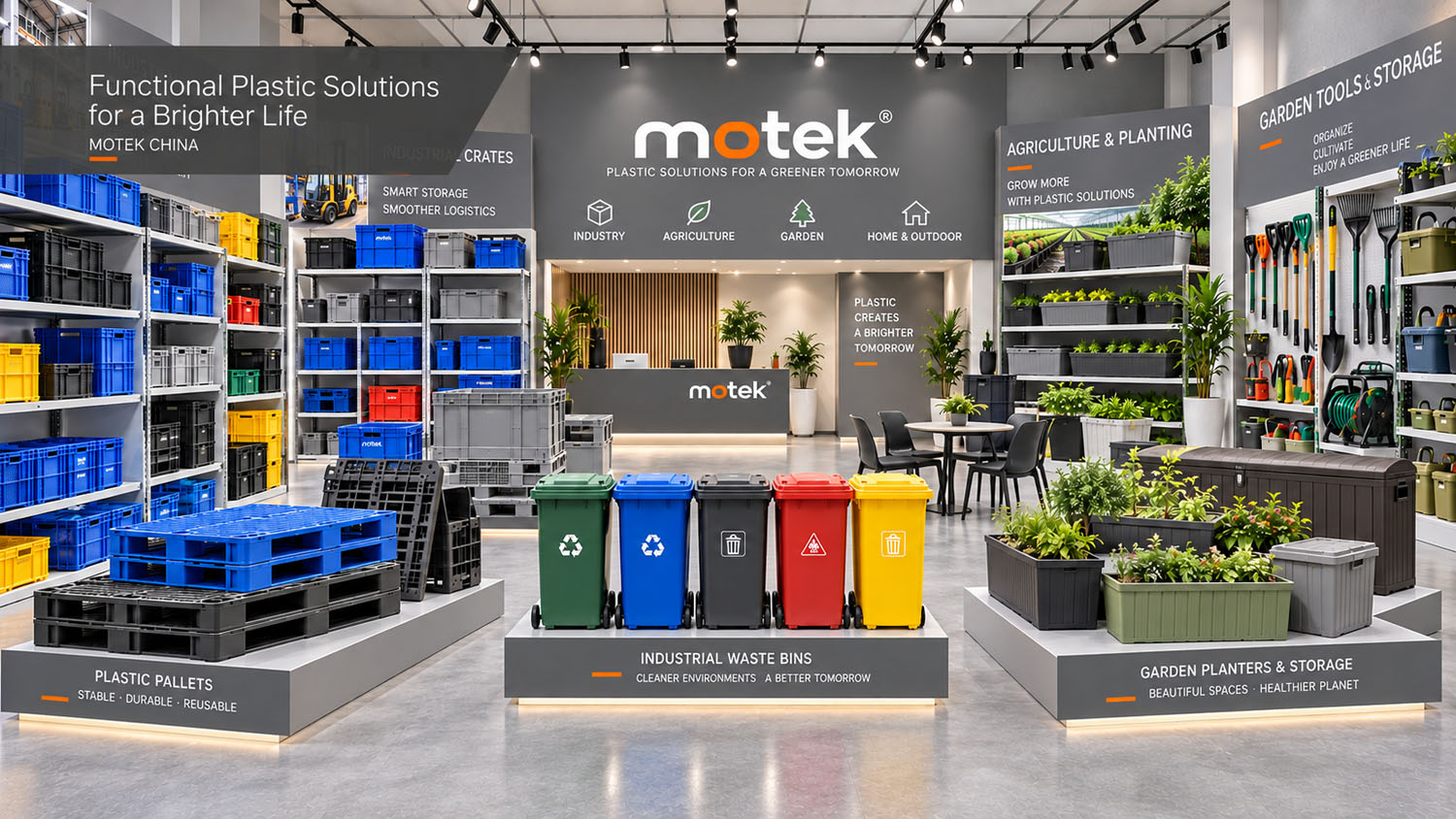
Motek — From household bins to industrial wheelie bins, providing reliable heavy-duty mold solutions for municipal and industrial waste management.
