


High-Back Armless One-Piece Plastic Chair Mold — Product Introduction (Motek Furniture Mold Series)
High-Back Armless One-Piece Plastic Chair Mold — Product Introduction (Motek Furniture Mold Series)
Product Positioning
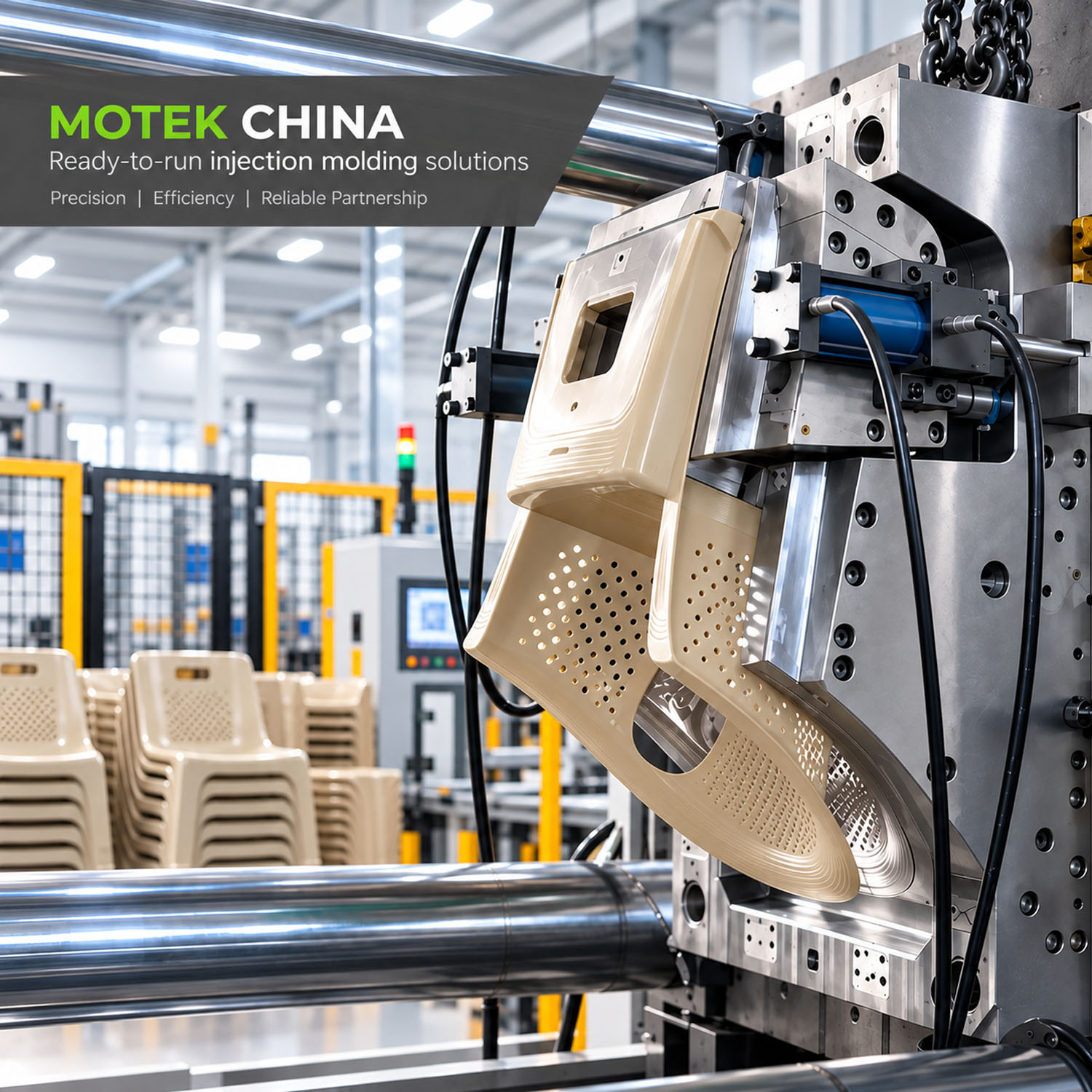
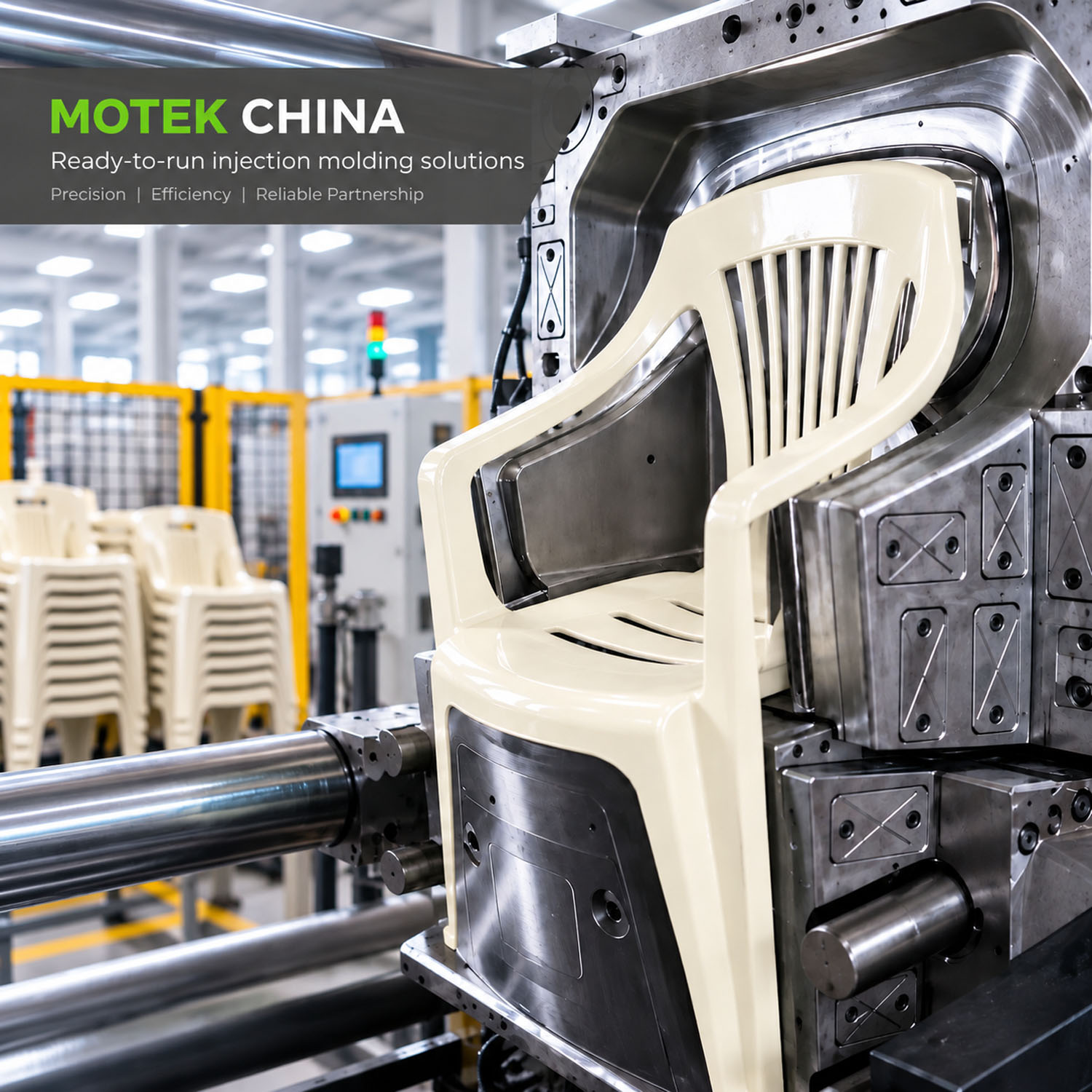
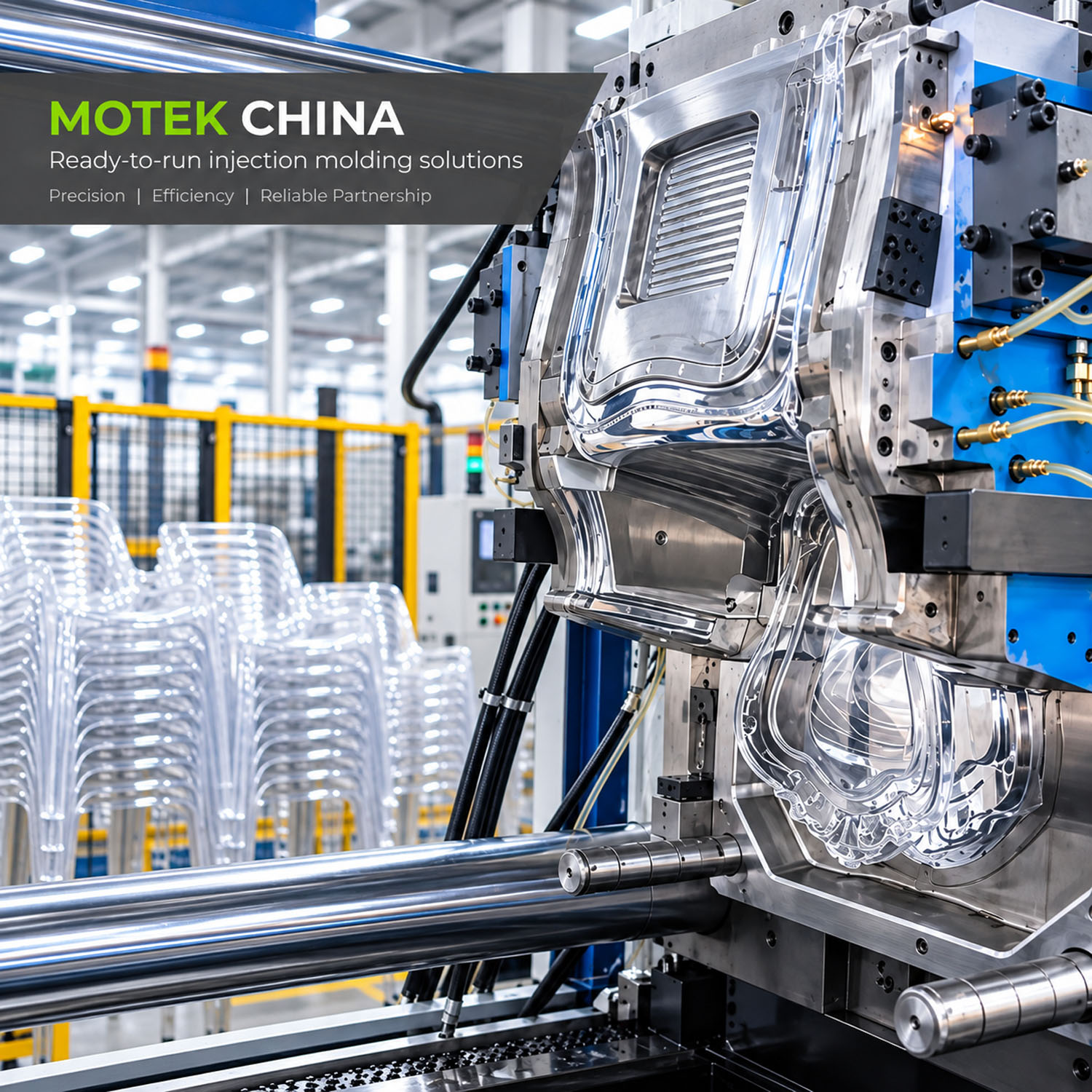
Motek introduces dedicated injection molds for high-back, armless, one-piece injection molded plastic chairs. The high-back design provides full back support, suitable for restaurants, conference rooms, training sessions, and prolonged sitting scenarios; the armless structure facilitates compact side-by-side placement and stackable storage. One-piece molding eliminates subsequent assembly steps and enhances structural integrity. The core challenges in mold development lie in filling and venting control for the high-back area, demolding mechanism design for the armless open chair body, and wall thickness uniformity and load-bearing assurance under one-piece forming. Motek configures dedicated solutions around mold flow analysis, demolding sequence design, and cooling optimization, helping customers achieve stable mass production of high-back armless one-piece chairs.
Core Specifications
| Item | Specification |
|---|---|
| Applicable Plastics | PP / PP+GF (reinforced material recommended for load-bearing applications) |
| Mold Material | P20 / 718H / DIN 1.2738 (cavity and core), nitriding recommended for sliders |
| Number of Cavities | Single cavity primarily |
| Mold Life | 500,000–1,000,000 shots |
| Cycle Time | 35–55 seconds (depending on chair size and cooling design) |
| Mold Base Standard | LKM / HASCO / DME or customer-specified |
| Runner System | Hot runner valve gate (gates concealed on non-appearance surfaces) / Cold runner optional |
| Demolding Method | Sliders/lifters first out + multi-point balanced ejection |
| Venting Design | Dedicated venting inserts at backrest weld line areas |
Product Features
Filling and Venting Control for the High-Back Area.
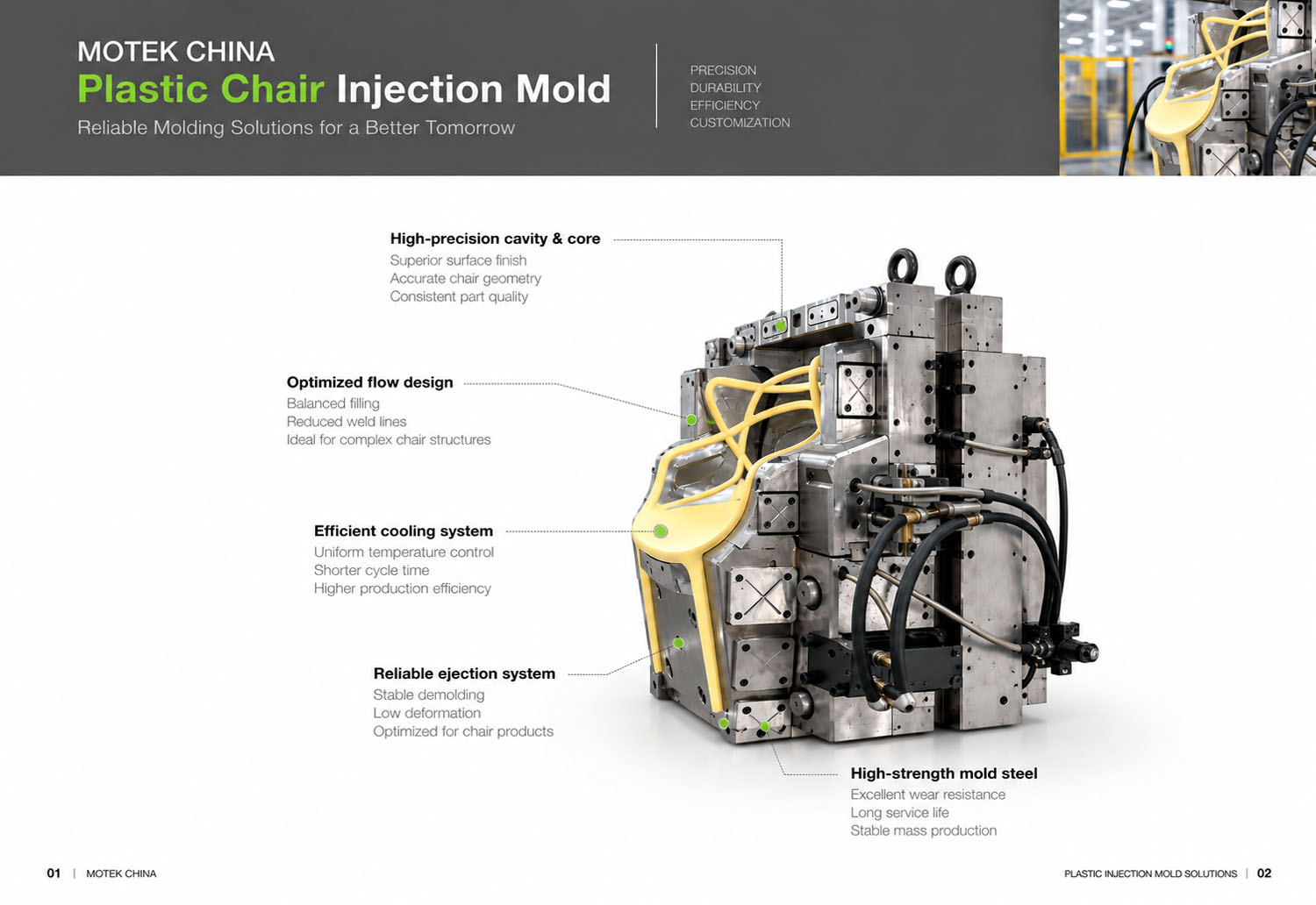
The long flow path of high backrests causes significant pressure loss when melt reaches the top of the backrest, prone to incomplete filling or visible weld lines. Motek optimizes gate positions and runner layout through mold flow analysis, ensuring uniform melt advancement in the backrest area. The backrest is a high-incidence area for weld lines; Motek provides dedicated venting inserts or vent grooves at venting locations determined by mold flow analysis, preventing incomplete filling or burning caused by trapped gas. For high-back chairs, gates can be positioned on the non-appearance surface of the seat underside, with hot runners or curved runners guiding melt into the cavity so that gate marks are hidden on the product's reverse side.
Demolding Mechanism for the Armless Open Structure.
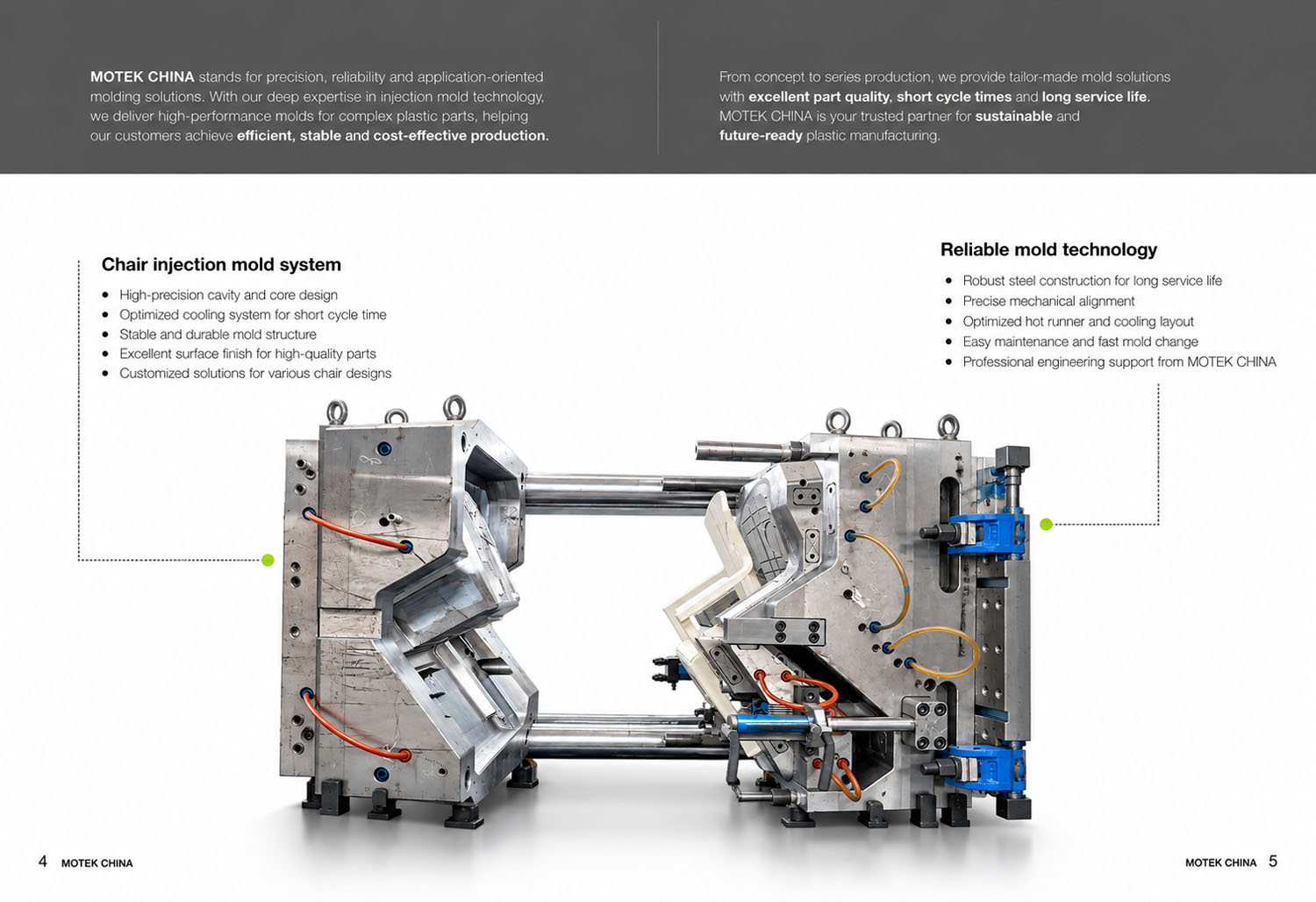
Armless chairs lack the gripping structures of armrests or a full backrest, presenting an open body form that is prone to deformation from uneven stress during demolding. Referencing industry multi-directional slider forming solutions, Motek configures sliders or lifter mechanisms for undercut features such as outward-splayed legs and curved seat surfaces. During mold opening, each moving component first separates to release constraints, then ejection is performed. For the curved transition area between the high backrest and the seat, a combination of lifters and straight ejectors can be adopted for demolding, ensuring the product is ejected only after constraints are fully released, preventing the high-back area from being scratched or deformed.
Wall Thickness Uniformity and Load-Bearing Assurance Under One-Piece Forming.
The leg-to-seat connection of high-back armless chairs is the primary load-bearing node. Motek ensures uniform wall thickness through high-precision cavity and core alignment, optimizing wall thickness transitions at leg roots and seat transition areas to avoid sink marks or stress concentration caused by abrupt changes. Reinforcement rib networks can be arranged on the seat underside to enhance rigidity, with rib thickness controlled at 50%–60% of main wall thickness to avoid sink marks on appearance surfaces. Mold flow analysis is used to evaluate filling end positions in the high-back area, with proper venting arranged to prevent weak points caused by trapped gas.
Concealed Gates and Appearance Surface Protection.
The backrest appearance surface of high-back armless chairs is the primary visual area, where gate marks directly affect product quality. Motek adopts hot runner valve gate or curved runner solutions, positioning gates on the seat underside or backrest reverse side—non-appearance areas. Ejection points are likewise preferentially arranged on non-appearance surfaces (seat underside, inner leg surfaces), ensuring no visible ejector marks on the appearance surface.
Cooling Efficiency and Cycle Time Control.
The high-back area has relatively concentrated wall thickness, and cooling time directly affects cycle time. Motek adopts zoned cooling channels at thick-wall nodes such as the backrest-to-seat connection, with high-thermal-conductivity beryllium copper inserts embedded where necessary, keeping mold surface temperature differentials within a small range to reduce backrest warpage caused by uneven cooling while shortening cooling time.
Applications
Motek high-back armless one-piece plastic chair molds are suitable for:
- High-back armless dining chairs for restaurants/conference rooms
- One-piece high-back chairs for training rooms/auditoriums
- Stackable high-back armless plastic chairs
- Modern minimalist high-back leisure chairs
- Commercial high-back seating (one-piece injection molded structures)
Service Process
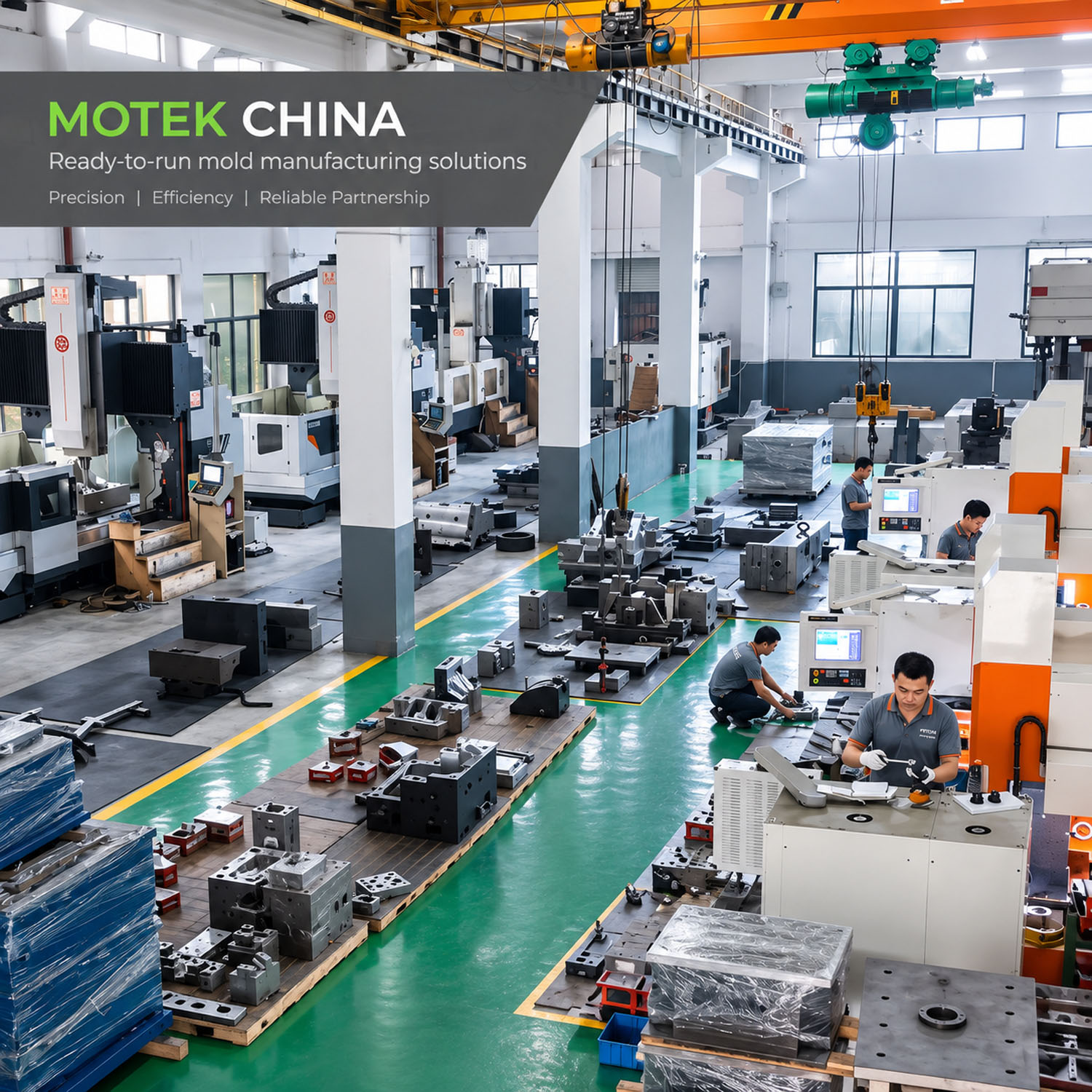
After the customer provides 3D product drawings, load-bearing requirements, and appearance standards, Motek completes mold flow analysis (including high-back filling and venting evaluation, wall thickness uniformity verification) and mold structure confirmation; cavity steel and moving components such as sliders/lifters are procured according to agreed specifications; progress and key milestones are regularly reported during processing. During trial molding, emphasis is placed on verifying filling completeness in the high-back area, weld line positions and appearance quality, and demolding mechanism smooth operation, with samples provided for confirmation. Before shipment, molds undergo anti-rust treatment and action testing, with water circuit diagrams, venting position diagrams, consumable parts lists, and maintenance instructions provided. Technical support is available during the warranty period, with lifetime maintenance consultation.
Motek — From low-back to high-back, from armrest to armless, providing reliable mold solutions for forming and demolding of one-piece injection molded plastic chairs.
