


Factory-Direct High-Quality Plastic Chair Molds | Custom-Made White Durable Home Chairs
Plastic Chair Mold with Wooden Legs — Product Introduction (Motek Furniture Mold Series)
Product Positioning
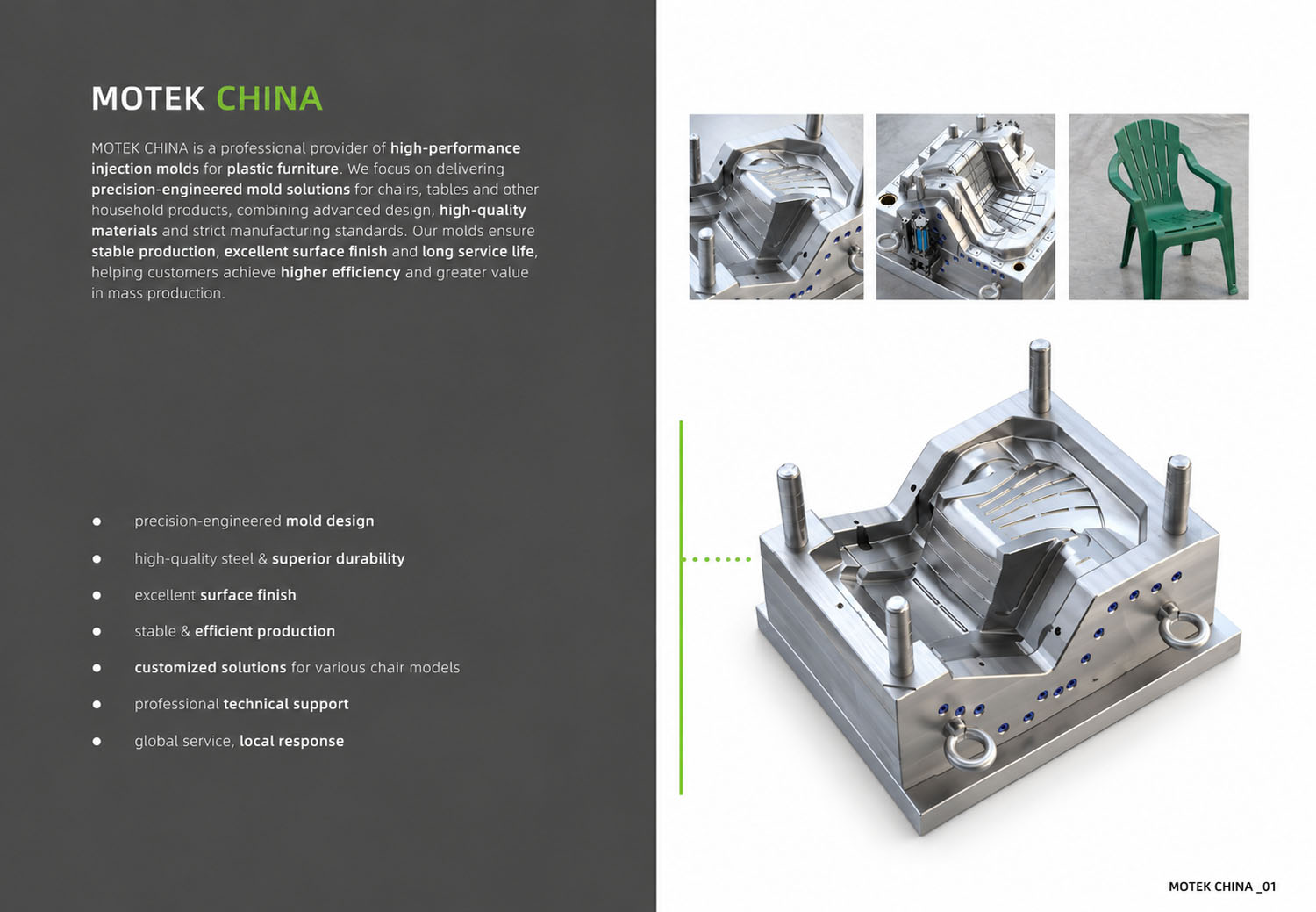
Motek introduces dedicated injection molds for chair products combining plastic seat/backrest with wooden legs. These products use injection molded components to form the complete seat and backrest, with wooden legs as separate components assembled afterward—combining the design freedom of plastic molding with the natural aesthetic of wooden legs, commonly used in dining chairs, leisure chairs, and commercial seating. The core challenges in mold development lie in precision control of the connection interface between seat and wooden legs, assembly clearance management between plastic parts and wooden legs, and structural strength and appearance quality of the injection molded parts themselves. Motek configures dedicated solutions around interface forming, assembly verification, and balanced ejection, helping customers achieve stable mass production of plastic-wooden leg assembly chairs.
Core Specifications
| Item | Specification |
|---|---|
| Applicable Plastics | PP / PP+GF (reinforced material recommended for load-bearing seat components) |
| Mold Material | P20 / 718H / 2738 (cavity and core), H13 optional for slider inserts |
| Number of Cavities | Single cavity primarily; 1×2 evaluable for small specifications |
| Mold Life | 300,000–800,000 shots |
| Cycle Time | 30–55 seconds (depending on chair type and cooling design) |
| Mold Base Standard | LKM / HASCO / DME or customer-specified |
| Runner System | Cold runner / Hot runner optional |
| Wooden Leg Interface | Screw seats/insertion seats/snap-fit mounting positions integrally formed, with dedicated tolerance control |
Product Features
Precision Control of Wooden Leg Connection Interfaces.
The assembly quality between plastic chair seats and wooden legs depends on interface precision. Motek forms screw seats, insertion seats, or snap-fit mounting positions in the mold, with dedicated tolerance control on hole diameter, depth, and locating features, ensuring tight fit and no loosening or wobbling after wooden leg assembly. Industry experience shows that after trial molding, wooden leg chair molds require focused inspection of assembly clearance between chair and wooden legs; Motek cooperates with customers on assembly verification during the trial molding stage.
Assembly Clearance and Structural Matching Management.
As separate components, wooden legs’ machining tolerances combined with plastic part shrinkage differences can easily cause uneven assembly clearances. Motek confirms the actual dimensional tolerance range of wooden legs with customers during the design phase, adjusting cavity interface dimensions accordingly with reasonable assembly allowances. For solutions where the same chair model accommodates both wooden and metal leg configurations, universal interfaces can be reserved in mold design or achieved through insert switching.
Structural Strength Assurance of Injection Molded Parts.
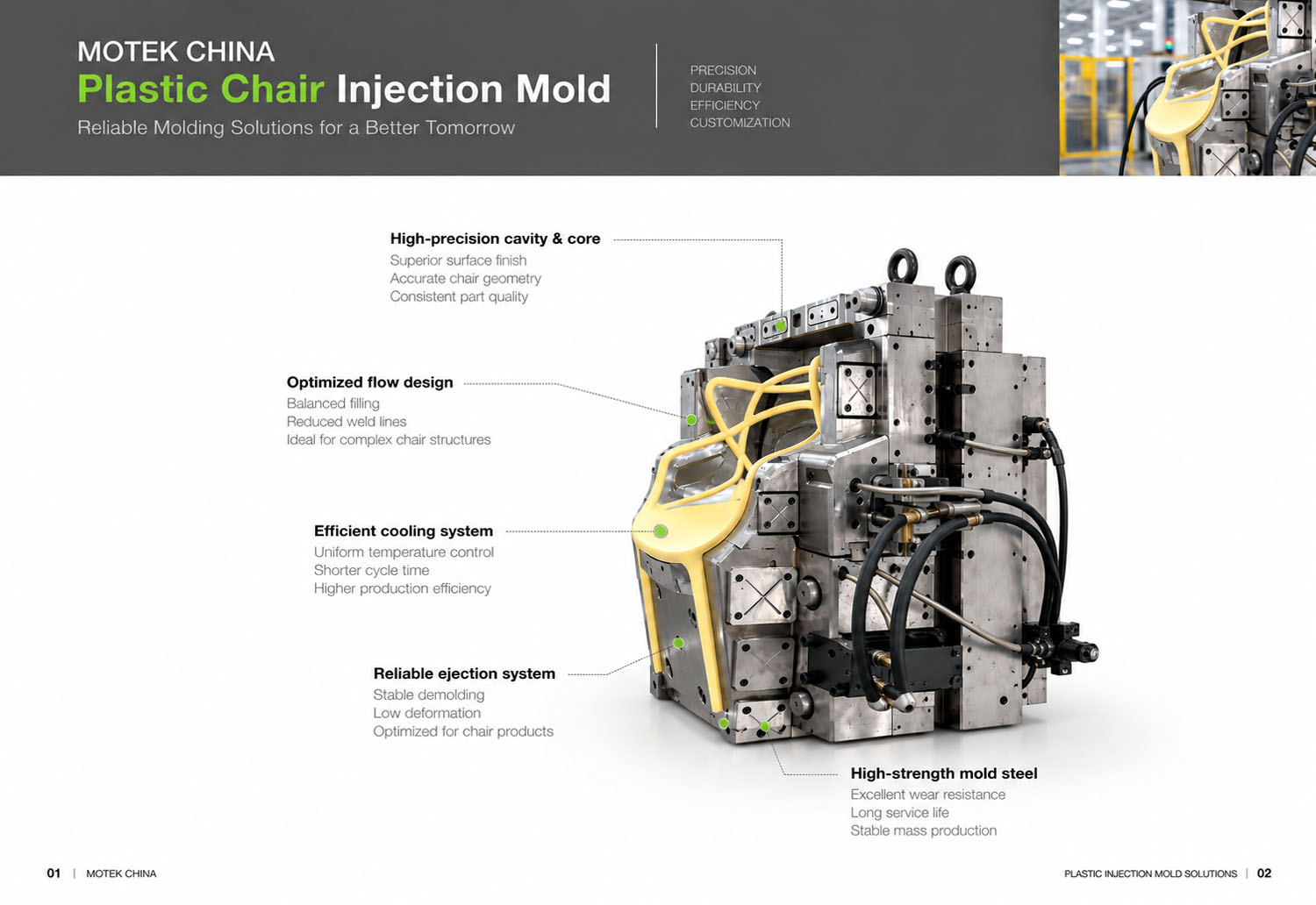
Plastic chair seats and backrests must bear human loads. Motek optimizes wall thickness transitions and reinforcement rib layout at seat load-bearing areas and around wooden leg mounting positions to avoid stress concentration. Mold flow analysis is used to evaluate filling end positions, with proper venting arranged to prevent weak points caused by trapped gas. Reinforcement ribs can be arranged on the seat underside to enhance rigidity, with rib thickness controlled not to exceed main wall thickness to avoid sink marks on the appearance surface.
Balanced Ejection and Appearance Protection.
Chair seats and backrests typically have high appearance requirements, and uneven ejection force can cause stress whitening or deformation. Motek adopts a multi-point balanced ejector pin or ejector block layout, with ejection points preferentially located in non-appearance areas (such as seat undersides and areas around wooden leg mounting positions), ensuring no visible ejector marks on the appearance surface during demolding.
Demolding Mechanism Optimized for Chair-Type Undercuts.
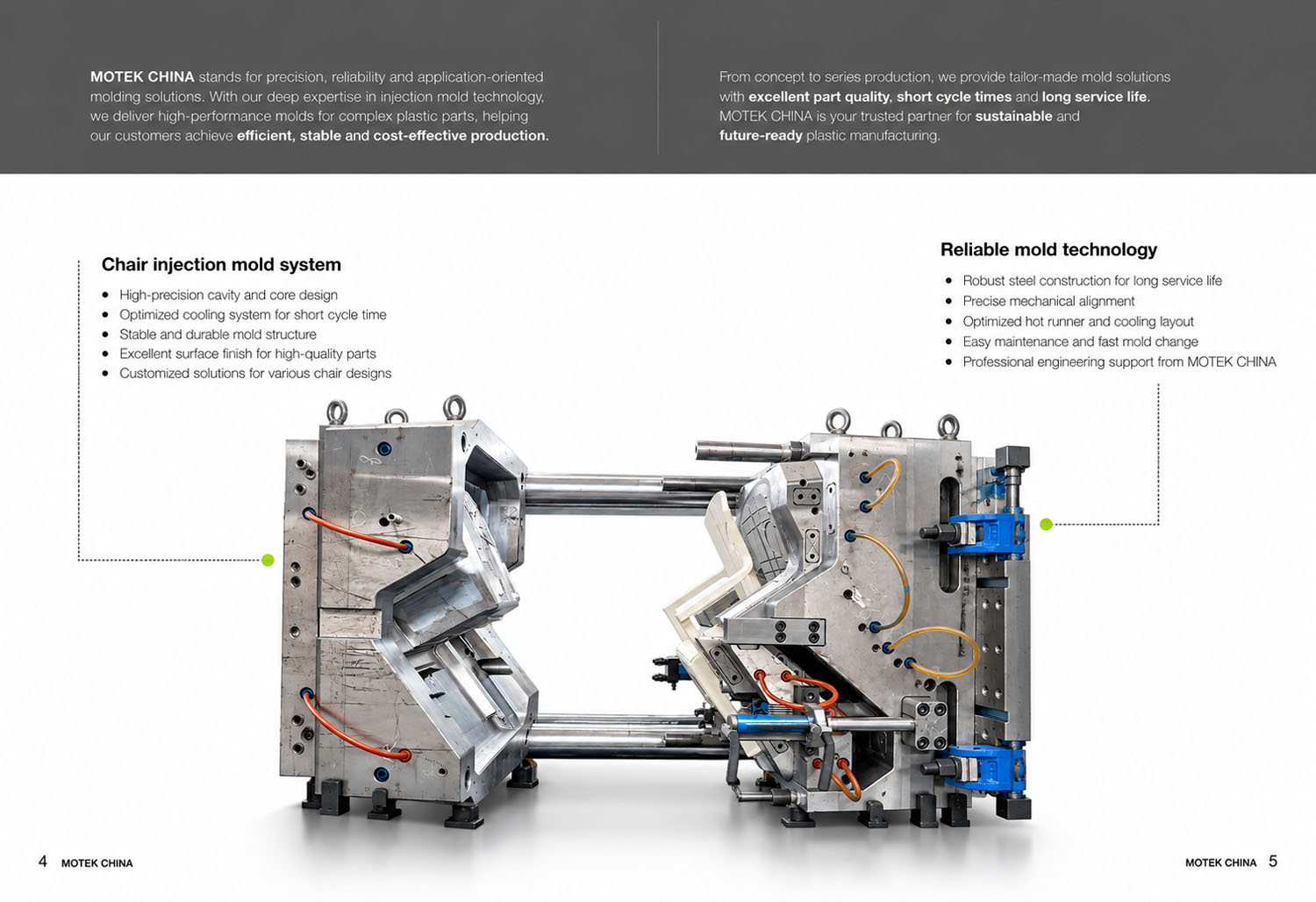
Plastic chair seats often feature edge flanges, curved armrests, and other undercut features. Motek designs slider or lifter mechanisms for these areas. During mold opening, sliders and inserts first separate to release constraints, then ejection is performed, preventing the product from being scratched or deformed during demolding.
Applications
Motek plastic chair molds with wooden legs are suitable for:
- Plastic seats/backrests for wooden-leg dining chairs
- Injection molded components for wooden-leg leisure chairs
- Wooden-leg commercial seating (cafes, restaurants)
- Plastic seat + wooden leg combination chairs (detachable packaging)
- Universal chair seat injection molded parts compatible with wooden/metal legs
Service Process
After the customer provides 3D product drawings, wooden leg interface plans, and assembly requirements, Motek completes mold flow analysis (including interface shrinkage compensation and structural strength evaluation) and mold structure confirmation; cavity steel and moving components such as sliders are procured according to agreed specifications; progress and key milestones are regularly reported during processing. During trial molding, emphasis is placed on verifying wooden leg assembly clearance, seat structural strength, and appearance quality, with samples provided for customer actual wooden leg assembly confirmation. Before shipment, molds undergo anti-rust treatment and action testing, with water circuit diagrams, consumable parts lists, and maintenance instructions provided. Technical support is available during the warranty period, with lifetime maintenance consultation.
Motek — From all-plastic chairs to plastic-wooden leg assembly chairs, providing reliable mold solutions for injection molding and assembly interfaces of mixed-material seating.
